Prof. Rudi A. Maturbongs: “Biodiversity Conservation for the Welfare of the People of West Papua and Southwest Papua”
By Paulus Laratmase
Translated (Indonesian-English) by Leni Marlina
–
November 18, 2025, Special report by suaraanaknegerinews.com in celebration of the 6th Anniversary of the Indonesian Catholic Scholars Association (IKDKI)
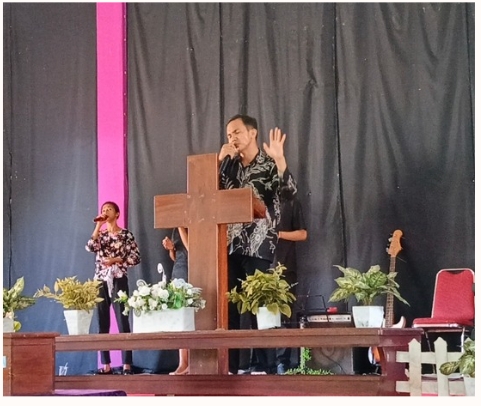
The National Seminar of the Indonesian Catholic Scholars Association (IKDKI) of West Papua and Southwest Papua gathered academics, researchers, and development stakeholders of Papua in celebration of IKDKI’s sixth anniversary. In this event, Prof. Dr. Ir. Rudi Aprianto Maturbongs, M.Si. delivered a presentation that was both refreshing and assertive: biodiversity conservation in Papua must not remain a global agenda detached from reality—it must be rooted in the welfare of Indigenous communities as its rightful custodians. With an academic approach strengthened by more than three decades of field experience, Prof. Rudi emphasized that West Papua and Southwest Papua are “strategic bio-cultural regions” whose protection requires an integrated approach linking policy, ecological science, and local knowledge.
In his presentation, he highlighted the ecological landscapes of the Bird’s Head Peninsula and the Bomberai Peninsula—ranging from the cloud forests of the Arfak Mountains, the giant mangrove ecosystems of Bintuni Bay, the wildlife corridor of Tambrauw–Maybrat, the karst systems of Sorong Raya, to the island clusters of Raja Ampat. These landscapes are not only rich in biodiversity but are also home to ethnic groups that have preserved centuries-old conservation wisdom, such as the Igya Ser Hanjob system, sasi practices, and customary zoning. Such living knowledge, he argued, is an ecological and cultural asset that must be integrated into modern policy frameworks.
Prof. Rudi also analyzed the intersection between global policy frameworks—such as the CBD, the Kunming–Montreal Global Biodiversity Framework, and Carbon Economic Value (NEK) schemes—and the local realities in Papua. He noted that national legal frameworks such as the Forestry Law and the Conservation Law provide formal foundations, yet leave gray areas that often give rise to tenure conflicts and even the criminalization of traditional practices. “Ecological justice must not be sacrificed for the sake of accelerated development,” he asserted. For this reason, every conservation program must guarantee FPIC, transparency, and equitable benefit-sharing for Indigenous communities.
In one of the most critical sections of his presentation, Prof. Rudi discussed the current state of social forestry in West Papua and Southwest Papua. Data indicates that Village/Community Forests have progressed relatively rapidly, while Customary Forests remain slow despite their strongest social legitimacy. Many permits exist only on paper, with inadequate institutional support. As a result, communities struggle to transform these permits into sources of livelihood or instruments for strengthening their bargaining power. He stressed that “social forestry cannot remain merely administrative; it must function as an economic, ecological, and political space for Indigenous peoples.”
Prof. Rudi then introduced three fundamental pillars for building welfare-oriented conservation: recognition of customary land rights, implementation of FPIC principles, and equitable benefit-sharing. Conservation, he argued, will only succeed when the state views Indigenous communities not as passive recipients of programs but as co-managers of their living landscapes. West Papua and Southwest Papua, he suggested, hold the potential to become a “living global laboratory” a world-class example of how governments, Indigenous communities, and non-state partners can build just and sustainable forest governance.
In closing, he offered several strategic recommendations: accelerating the recognition of Customary Forests, strengthening village/clan institutions, integrating local knowledge into conservation planning, designing fair carbon schemes, and establishing a collaborative research base that merges biodiversity data with social data. “If we are truly committed to sustainability,” Prof. Rudi concluded, “then Indigenous communities must lead not be escorted from behind.”
Brief Profile of Prof. Dr. Ir. Rudi Aprianto Maturbongs, M.Si.
Prof. Rudi A. Maturbongs is a forestry scholar who has devoted more than three decades of his career to forest conservation in Papua and to strengthening higher education in eastern Indonesia. He completed his Bachelor’s degree in Forestry (1989), Master’s degree in Biology (2003), and Doctorate in Forestry Science (2015). Since the early years of his professional journey in the FAO–PHPA and WWF Irian Jaya projects, he recognized that forest protection can only succeed when grounded in the knowledge of Indigenous landowners.
At the University of Papua, he has served as Dean of the Faculty of Forestry (2007–2011) and Director of the Graduate Program (2016–2020), driving strategic research on deforestation, climate change, and community-based natural resource management. His core interests include biodiversity, habitat connectivity, and community-based resource governance. For Prof. Rudi, Papua’s forests are living knowledge systems that must be passed on to future generations who are both well-educated and grounded in character.