Sensing Spirituality and Modern Reality in Rizal Tanjung’s Poem “The Silent Wings and the Flower at the Edge of Light” (2025)
Essay by Leni Marlina
–
There are moments when a poem is not merely read but deeply felt. The Silent Wings and the Flower at the Edge of Light by Rizal Tanjung is one of those rare pieces. As I read it, I felt as though I were sitting at the edge of the night, accompanied by a single strand of light descending softly from the sky—calm yet stirring. From its very first line, the poem opens a door into an inner chamber of silence, tenderness, and spiritual mystery.
Rizal does not simply write poetry; he writes the essence of human experience—loneliness, hope, and the eternal journey toward meaning. This poem serves as the opening piece in his Sufi Poetry Anthology, published in 2025 on the digital platform Suara Anak Negeri News (suaraanaknegerinews.com). From this very first poem, one can sense that Rizal is not playing with words; he writes like a pilgrim returning from a long inward voyage. Through his lines, readers are invited to experience and contemplate spirituality within the frame of modern reality.
The central theme of this senior poet and artist from West Sumatra is profoundly captivating: beauty born of wounds. From the opening verse—
“In the still valley of night, I found a feather of light, falling gently from the wing of time that flew too close to silence”—
we are greeted by imagery that is tranquil yet profound. The night is not a mere backdrop; it is a mirror of solitude, a space for reflection. That “feather of light,” to me, feels like a fragile prayer—hovering between faith and doubt.
Heidegger (1962) once wrote that human beings, or Dasein, always live within the existential experience of being-in-the-world. The feather of light becomes a living metaphor for this vulnerability—a depiction of humanity’s fragile search for meaning amidst the stillness of being.
The symbolism in this poem is rich and delicately woven. The feather of light, the wings, the flower at the edge of light—all speak in a language subtler than logic. The feather evokes fragility; the wings suggest inner freedom; and the flower at the edge of light becomes a symbol of love and renewal.
One of my favorite lines reads:
“The feather did not belong to a bird, but to the breath of an angel who lost direction, from a soul that once touched God but now drifts within the human body.”
Here, Rizal moves fluidly between heaven and earth. He speaks of a lost angel—an exquisite metaphor for the human condition, once near divine perfection yet suddenly disoriented. Rilke (1907) once said that beauty is born from tension and loss, and Rizal brings this idea to life with extraordinary gentleness.
Barthes (1975) described every text as a tissue of quotations—a woven fabric of universal experiences. That truth is palpable here. Within Rizal’s imagery, we find traces of every soul: the lost angel, the falling feather, the flower blooming at the edge of light—all reflections of our own being.
The poem’s imagery breathes. Consider this:
“The colors of the night spun: blue prayed, red wept, and black kept the secret before the word.”
Isn’t that remarkable? Suddenly, colors are no longer visual; they become emotions. Blue is no longer merely blue—it is a prayer. Red is no longer red—it is an uncontainable cry. And black—ah, black becomes the mystery before existence itself. This poetic technique, known as synesthesia, allows the senses to merge, letting us not only see color but hear and feel it simultaneously.
Ezra Pound (1913) once urged poets to engage in the direct treatment of the thing—to convey impressions with utmost sincerity through vivid images. Rizal achieves this beautifully. Nothing feels excessive, yet everything is alive. Reading his lines, one feels as though walking alongside that falling feather, trembling with the air that hesitates between descent and return.
Rizal’s language is both tender and tense. He knows precisely when to pause, when to make the reader hold their breath:
“It trembles in the air like a hesitant prayer, between falling and returning to its origin.”
This line is simple yet powerful. There is vibration, rhythm, and an unspoken spiritual tension. The rise and fall of the verse mirrors breathing itself, drawing readers into a meditative rhythm. This poem converses not merely with the intellect but with the soul.
What I love most is that Rizal never distances his poetry from the reader. Though rich with spiritual and symbolic depth, his diction remains intimate. One could read this poem while sipping tea in the late afternoon and still be gently moved by its quiet profundity.
And then comes the reflective final line:
“And I knew—everything that falls does not always lose its way; sometimes it is bowing in its journey home to the light.”
Anyone who reads this must pause. The line is not only beautiful but consoling. It gives us space to forgive ourselves, to understand that falling is not failure. Heidegger (1962) reminds us that limitation is an inherent part of human existence; Ricoeur (1984) notes that we understand ourselves through the narratives we continue to build; and Kristeva (1982) suggests that wounds can be sources of meaning. Rizal unites all these ideas in one luminous line—that falling can be a form of prostration, and prostration a form of return.
When examined line by line, the poem reveals a structure that is both delicate and powerful. It begins in the “valley of night,” a symbol of solitude and reflection. The “feather of light” follows, embodying fragility and hope. The “wing of time” evokes tension between temporality and silence—the space where humanity’s deepest unease resides. Then comes the “lost angel,” a spiritual yet deeply human emblem. Finally, the “flower at the edge of light” blooms as a sign that love and growth remain possible, even from the deepest wound.
Rizal further layers emotion through color: blue, red, black. Each becomes a tonal vibration of the soul. Blue invites prayer, red invites tears, and black embraces secrets not yet ready to be revealed. Together, they create a warm space for contemplation.
Aesthetically, the poem’s strength lies in its harmony. Symbols, images, language, and rhythm dance together without domination. This is not a poem meant merely to dazzle with beauty; it is meant to be felt. It reminds us that beauty can rise from vulnerability, that even wounds can glow into new light. This is a meditation—both tranquil and awakening—inviting us to return to ourselves.
What I admire most is its universality. Though born from the heart of an Indonesian poet, its resonance transcends boundaries. Anyone can find their own “feather of light,” recognize the “lost angel” within, and understand that the journey toward light is a journey shared by all humankind. That is the power of true literature—it touches the universal without severing its local roots.
Within the context of contemporary Indonesian poetry, Rizal Tanjung’s work demonstrates that poetry remains a bridge between spirituality and modern reality. He writes with the heart of a pilgrim and the aesthetic awareness of an artist. The Silent Wings and the Flower at the Edge of Light is not merely a poem to be read; it is an inward experience to be lived.
Perhaps after reading it, you too will sit for a moment, look toward the sky, and quietly ask yourself:
“Is that feather of light also falling for me?”
And perhaps, in that moment, you will find your own small light—guiding you gently home.
—–
The Silent Wing and the Flower at the Edge of Light
Poem by Rizal Tanjung
Translated (Indonesian-English) by
Leni Marlina
In the still valley of night,
I found a feather of light,
falling softly from the wing of time
that had flown too close to silence.
It trembled in the air like a hesitant prayer,
between the will to fall and the longing to return.
At its tip bloomed a tiny flower—
like a heart that never wished to be born,
yet could not refuse the call of love.
That feather belonged not to a bird,
but to the breath of an angel lost in direction,
a soul once brushed by the touch of God,
now stranded within a human body.
The colors of night began to whirl:
blue in prayer, red in tears,
and black guarding a secret before the word.
I heard a whisper—
“Every beauty is a wound illuminated by love.”
And I knew—
not all that falls has lost its path;
sometimes it kneels in reverence,
journeying home
toward the light.
West Sumatra, Indonesia, 2025
—
REFERENCES
Barthes, R. (1975). The Pleasure of the Text (R. Miller, Trans.). New York, NY: Hill and Wang.
Heidegger, M. (1962). Being and Time (J. Macquarrie & E. Robinson, Trans.). Oxford, UK: Blackwell.
Kristeva, J. (1982). Powers of Horror: An Essay on Abjection (L. S. Roudiez, Trans.). New York, NY: Columbia University Press.
Pound, E. (1913). Make It New. New York, NY: Alfred A. Knopf.
Ricoeur, P. (1984). Time and Narrative. Chicago, IL: University of Chicago Press.
Rilke, R. M. (1907). Letters to a Young Poet. Leipzig, Germany: Insel-Verlag.
Tanjung, R. (2025). The Silent Wings and the Flower at the Edge of Light. Suara Anak Negeri News. https://suaraanaknegerinews.com/sayap-sunyi-dan-bunga-di-ujung-cahaya/
———
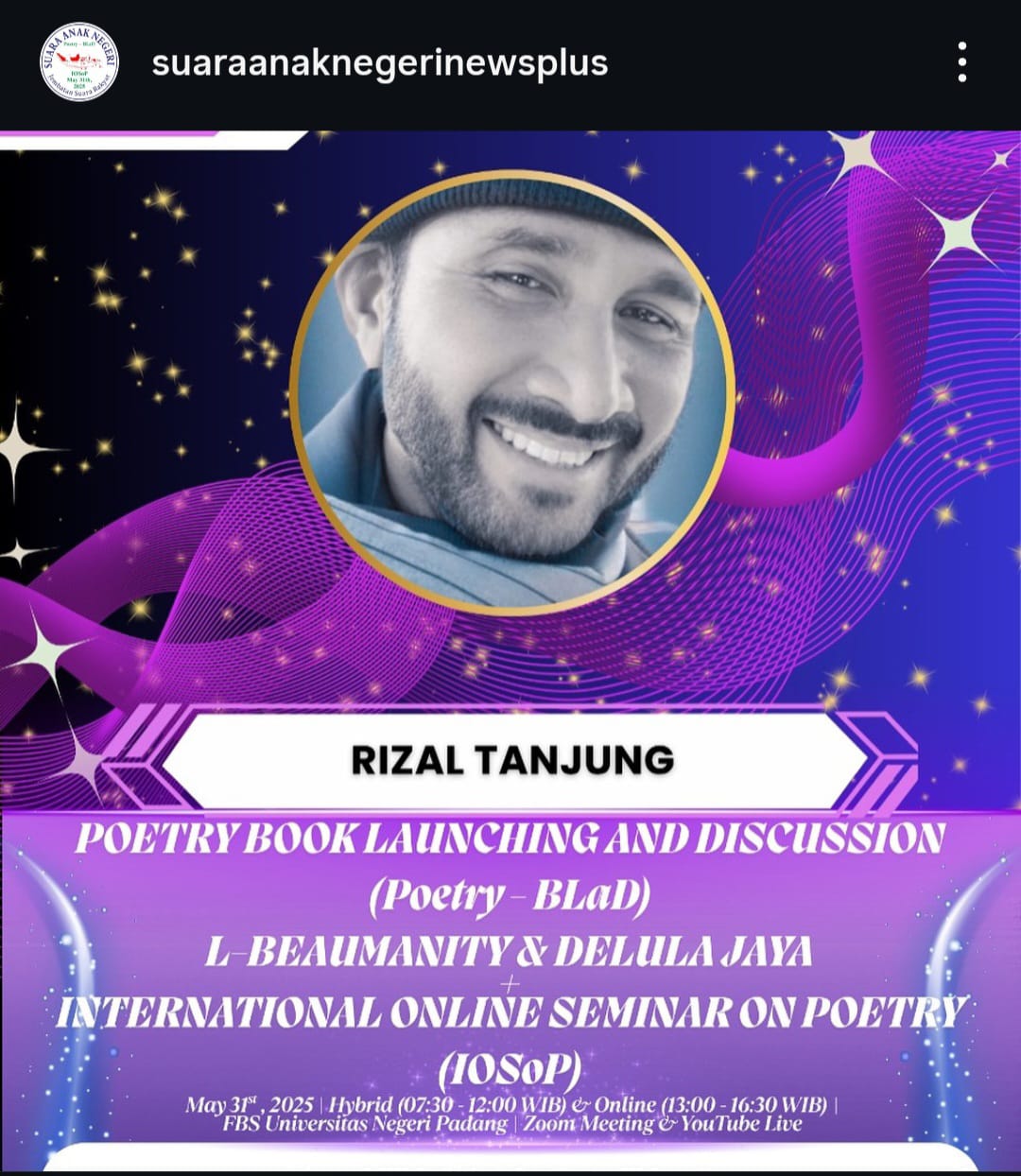
About the Poet: Rizal Tanjung
Rizal Tanjung, an artist and cultural figure born in Padang on February 5, 1959, stands as one of the most significant contributors to the theatre and cultural landscape of West Sumatra. A graduate of the Indonesian School of Fine Arts (SSRI) Padang, Rizal began his artistic journey in 1975. In 1979, he founded the Moeka Theatre Group, which later evolved into Old Track Teater in 2004.
Under his direction, more than sixty plays have been performed across various provinces in Indonesia — affirming his pivotal role as a driving force behind regional theatre that remains deeply rooted in local culture while embracing creative innovation.
Beyond his work as a director, Rizal is also a prolific writer whose works have appeared in both local and national media. His creative repertoire spans stage plays, short stories, serialized fiction, poetry, cultural essays, and papers on the development of traditional and contemporary arts. Some of his most notable plays include Sandiwara Sandiwara, Minus I, Minus Adab, Melody, Kaco Batuang, Sutan Lanjuangan, Harimau Agam di Negeri Cina, The Trilogy of the Origins of Lake Maninjau, Syair dan Melody, Sang Pemimpin, Ruang Hampa, and the kaba (traditional Minangkabau narrative) Cinto Dilarai dek Kurambiak.
Rizal’s influence also extends into institutional and cultural leadership. He has served as Chairman of Teater Moeka Padang, Old Track Arts Institute, Sekapur Sirih Educational Foundation, and the Forum for Traditional Media Communication (FK-METRA) Padang, as well as a board member of Lembaga Bumi Kebudayaan. He has also been an active member of both the West Sumatra Arts Council and the Padang Arts Council.
As a speaker, juror, critic, and curator, Rizal has frequently collaborated with government bodies such as the Departments of Tourism, Education, Culture, and Communications, as well as the Cultural Park Unit (UPTD Taman Budaya), universities, and the Balai Pelestarian Kebudayaan (BPK).
Through his enduring work and dedication, Rizal Tanjung has become a cornerstone of contemporary Minangkabau culture—faithfully preserving tradition while continually exploring new aesthetic possibilities in Indonesia’s performing arts scene.
—
About the Reviewer: Leni Marlina

Leni Marlina is a writer, poet, and lecturer at Universitas Negeri Padang, West Sumatra, Indonesia, where she has taught since 2006. She is the Founder and Head of several digital-based social and literary communities focused on literacy, creative writing, translation, and social entrepreneurship.
Among the communities she established are the Pondok Puisi Inspirasi Pemikiran Masyarakat Indonesia (PPIPM-Indonesia), Poetry-Pen International Community (PPIC), Translation Practice Community (Trans-PC), English Language, Literature, and Literacy Community (E4LC), Literary Talk Community (Littalk-C), World Children’s Literature Community (WCLC), and Starcom Indonesia.
Leni is also an active member of the ACC Shanghai Huifeng International Literary Association (ACC SHILA), Indonesian Writers Association (SatuPena – West Sumatra), Penyala Literasi Sumbar (PLS), and the World Poetry Movement (WPM) Indonesia, among others.
Her dedication to literature, education, and community empowerment continues to inspire creative and intellectual growth across Indonesia and beyond.
—
The Indonesian version of the essay above is available in the attached official link below.