Rereading “The Wild Iris” (1992) by Louise Glück – the American Woman Poet and Nobel Laureate in Literature (2020

Figure 1: Louise Glück, distinguished American poet and recipient of the 2020 Nobel Prize in Literature. Image source: tra•vers•ing
An Essay by Leni Marlina, S.S., M.A.
English Languange and Literature Department, Faculty of Languages and Arts, Universitas Negeri Padang
—
Why do we continue to read poems that do not shout?
Why, in a world saturated with loud declarations, do we find ourselves returning to voices that almost whisper?
Louise Glück does not appear to write in order to seduce her readers through immediacy. Her poems do not offer easily recognizable emotions, nor do they provide ready-made consolation. And yet, perhaps precisely because of this, they continue to be reread, even by those who initially feel uneasy inhabiting the space of her poetry.
When the Nobel Prize in Literature was awarded to Glück in 2020, many new readers asked the same question: what is actually special about poems that seem so simple on the surface? The answer does not lie in formal simplicity, but in a radical refusal to falsify experience. Glück writes from a place we rarely enter willingly: a terrain of suffering that is not quickly assigned meaning.
Among her many works, “The Wild Iris” (1992) most clearly embodies this stance. The book does not offer a narrative of healing. It offers endurance. There is no emotional climax, no comforting resolution. Instead, we encounter voices sometimes human, sometimes floral, sometimes divine, that intersect without ever fully reconciling. And it is precisely there that the poem’s power begins.
World Literature: When Poetry Does Not Come from a Single Place
If world literature is understood merely as a canon of famous works from different nations, “The Wild Iris” may seem too “local,” too personal, too quiet. But if world literature is understood as a mode of reading, as a site where human experience encounters itself across cultures, then Glück’s poetry stands firmly within it.
The poems in “The Wild Iris” do not depend on specific American social contexts. They do not require the reader to master a particular history, political moment, or cultural conflict. They ask for only one thing: a willingness to listen. And the experiences of listening, silence, injury, and loss are not confined by geography.
For this reason, when reading Glück, one may faintly hear echoes of Bashō: nature speaking without excess emotion. When encountering a voice that survives suffering, one may recall Akhmatova, who wrote not to complain, but to bear witness. Readers familiar with Forugh Farrokhzad may sense a similar courage, the courage to speak from a place of vulnerability.
In this way, “The Wild Iris” lives as world literature not because it seeks universality, but because it remains faithful to what is most personal.
Louise Glück does not trust overly beautiful language, not because she rejects beauty, but because she is wary of falseness. Excessive sweetness, for her, often conceals a small dishonesty: the desire to soothe oneself too quickly.
In The Wild Iris, every line feels tested: does this word need to exist? Is this truly what was experienced? There are no emotional explosions. Even suffering is narrated at a distance, as if the poet understands that excessive proximity to emotion can distort experiential truth.
This restraint distinguishes Glück’s poetry from sentimental confessional verse. She does not write to “release” emotion, but to hold it. And it is precisely within this holding that readers are invited, not as spectators of emotion, but as witnesses.
The poem does not cry out to be understood. It says instead: this is what happened; stay here for a moment, if you dare.
Let us pause at the poem’s now-famous opening lines:
/ At the end of my suffering
there was a door. /
What do we imagine when we read the word door? Hope? Escape? Light?
Glück offers no answer. She deliberately stops there. There is no description of what lies beyond the door. And it is precisely this absence that matters. Suffering is acknowledged, but it is not granted an easy meaning.
The speaking voice in the poem is a flower, something we usually associate with beauty, renewal, and life. Yet in Glück’s hands, the flower speaks of death, of buried consciousness, of the terror of continued existence.
Nature here is not a refuge from suffering. It is an honest mirror. It does not side with humanity. It simply exists, and in doing so reminds us that life continues without any obligation to comfort us.
The silence surrounding these poems is not emptiness. It is an ethical space, a space in which readers are forced to confront experiences we usually pass over quickly: unfinished grief, uncertain faith, hope too exhausted to promise anything.
Metaphors in “The Wild Iris” do not function as explanations; they function as guardians of ambiguity. Doors, soil, weak light, water, all appear without moral instruction.
When the lyric voice states that whatever returns from oblivion will “find a voice,” we may be tempted to read this as triumph. But read slowly, and it becomes clear that this voice is not the result of healing. It is the consequence of inevitable survival.
The deep blue water at the poem’s end is not divine illumination. It is heavy, dense, and real. It does not erase wounds; it shows that from the center of experience, including pain, there remains an energy that continues to exist.
One of Glück’s most radical gestures is her willingness to let God remain distant. In “The Wild Iris”, God does not appear as a solution. The divine voice is sometimes defensive, sometimes nearly silent.
Human prayers are not always answered. Questions of justice remain unresolved. And the poem refuses to patch these tensions with a sweetened faith.
This stance may unsettle religious readers. Yet it is precisely this unease that feels honest. Glück understands that mature faith is not always serene; it is faith that dares to remain within questions.
The seasonal structure of “The Wild Iris” is often read as a symbol of hope. A more careful reading suggests otherwise: cycles do not guarantee redemption. Spring does not erase the memory of winter.
Life repeats itself, and wounds repeat with it. There is no straight path toward healing, only the continuation of days, of seasons.
And perhaps this is the most honest consolation poetry can offer: not the promise that everything will be fine, but the acknowledgment that endurance itself is already difficult, and already meaningful.
Poetry as Ethical Experience
In an age that celebrates grand emotions and instant declarations, “The Wild Iris” poses an uncomfortable question: are we still capable of listening to a voice that does not try to charm us?
Louise Glück does not write to make us feel better. She writes to make us more honest. Her poetry teaches that silence is not weakness, that wounds do not need to be healed to deserve articulation, and that a surviving voice, even a quiet one, carries profound ethical force.
In that silence, “The Wild Iris” continues to live. It does not shout. It does not plead. It simply says: I am still here.
And perhaps that is the rarest form of literary courage.
Rereading “The Wild Iris”: Poetry as a Literary Experience
To fully grasp the power of “The Wild Iris”, we must return to the poem itself. not to uncover hidden meanings, but to observe how language restrains, opens, and unsettles the reader’s consciousness. This poem does not merely say something; it does something to us.
The poem opens with a sentence that is almost flat in tone:
/ At the end of my suffering
there was a door. /
Syntactically, the sentence is simple. There is no layered metaphor, no musical flourish. Yet this very simplicity creates pressure. The phrase the end of my suffering usually signals resolution. Glück suspends that expectation with the word door, a threshold, not a destination. A door suggests possibility, not certainty. It may open, or it may remain closed.
From the first line, the reader enters unstable territory: suffering is acknowledged, but denied final meaning.
The next lines further complicate expectation:
/ Hear me out: that which you call death
I remember. /
Instead of presenting death as the unknown, the voice claims memory. Yet this claim does not lead to revelation or enlightenment. What follows are ordinary details:
/ Overhead, noises, branches of the pine shifting.
Then nothing./
There is no light, no metaphysical vision, only the sound of pine branches, followed by emptiness. Glück deliberately rejects spectacular narratives of death. Death is not an exalted event; it is a cold, silent interval.
The line “Then nothing” exemplifies Glück’s use of emptiness as a poetic strategy. She does not fill the void with meaning; she lets it hang, forcing the reader to feel its weight.
One of the poem’s most powerful moments is the image of buried consciousness:
/ It is terrible to survive
as consciousness
buried in the dark earth. /
The word terrible is crucial. Survival, often framed as positive, is here described as horrifying. Consciousness buried in soil evokes a deeply physical metaphor: life without agency, without voice.
This image may resonate as trauma, depression, or spiritual loss. Yet Glück refuses to anchor it to a single psychological interpretation. She leaves the metaphor open, allowing readers from diverse backgrounds to locate their own resonance.
A significant shift occurs when the speaker declares:
/ I tell you I could speak again:
whatever returns from oblivion returns
to find a voice. /
Here, speech is not celebrated as triumph. It is reported almost neutrally. Voice is not a privilege, but a consequence of continued existence. Whatever returns from nothingness, not only flowers, not only humans, seeks a voice. Speaking thus becomes an ethical act, not an assertion of ego.
The poem closes with an image often misread as redemption:
/ from the center of my life came
a great fountain, deep blue
shadows on azure sea water. /
Yet this water is not transcendent. Its depth and shadow suggest weight, not spiritual clarity. This is not baptismal water, but living energy emerging from the core of experience, including pain.
By ending here, Glück refuses moral resolution. There is no explicit conclusion, no optimistic directive, only the ongoing movement of life, without promise of ease.
Literature that Trains Patience Toward Questions
From this analysis, it becomes clear that “The Wild Iris” is not a poem that seeks to instruct. It does not deliver moral messages in declarative form. Instead, it invites readers into a particular mode of thinking: slow, hesitant, and ethically responsible toward language.
The poem demands an ethics of reading. It asks us not to rush toward meaning, not to force wounds into lessons, and to allow silence to work.
This is why The Wild Iris endures across generations and cultures. It does not depend on ideology or historical context. It lives through linguistic precision and ethical courage.
If poetry is one way humans survive without falsifying experience, then The Wild Iris stands as a profoundly honest example of that practice. It does not save its readers. It accompanies them, in silence, at the threshold, in a voice that has just returned from nothingness.
And perhaps that is where its singular literary power resides
I did not first read “The Wild Iris” as an academic. I read it as a tired reader, tired of the constant demand to explain, to conclude, to close experience with tidy meaning. Louise Glück’s poem did not help me understand life more easily; it reminded me that not everything needs immediate understanding.
As a literature lecturer, I am accustomed to guiding students toward themes, symbols, and messages. Yet “The Wild Iris” reveals something more fundamental: before all that, there must be a willingness to remain, to remain within sentences that do not answer, within silences that resist comfort, within the awareness that something has occurred but cannot yet be named.
In the classroom, students often ask, “What does this poem mean?” It is a valid question. But when reading Glück, I have learned to respond with another: “Which part made you uncomfortable?” That is often where the real conversation begins.
This poem does not teach optimism, nor does it teach despair. It teaches endurance, not as a slogan, but as a quiet experience. The endurance to speak even when the voice is soft. The endurance to resist turning wounds into instant wisdom. The endurance to accept that life rarely offers satisfying closure.
As both reader and teacher, I am increasingly convinced that literature like this matters not because it is “beautiful,” but because it is honest. It trains ethical sensitivity: when to speak, when to remain silent, and when to stop interpreting in order to respect experience.
In an academic world often seduced by speed, output, and conclusions, “The Wild Iris” offers another rhythm: slow reading, unhurried thought, a life that does not always move forward but sometimes simply remains.
Perhaps this is the most valuable lesson Louise Glück’s poetry offers: that a voice returning from nothingness does not always bring good news. Sometimes it merely says, I am still here. And that is enough.
As a reader, as a lecturer, as a human being, I learn to accept that not all doors need to be opened. Some only need to be acknowledged, as signs that we have passed through something, and have chosen, still, to speak. (LM-2026)
—-
Appendic
THE WILD IRIS
Poem by Louise Glück
–
At the end of my suffering
there was a door.
Hear me out: that which you call death
I remember.
Overhead, noises, branches of the pine shifting.
Then nothing. The weak sun
flickered over the dry surface.
It is terrible to survive
as consciousness
buried in the dark earth.
Then it was over: that which you fear, being
a soul and unable
to speak, ending abruptly, the stiff earth
bending a little. And what I took to be
birds darting in low shrubs.
You who do not remember
passage from the other world
I tell you I could speak again: whatever
returns from oblivion returns
to find a voice:
from the center of my life came
a great fountain, deep blue
shadows on azure sea water.
—-
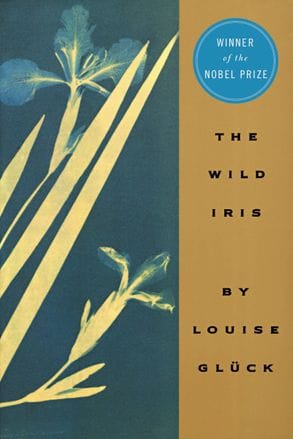
About the Poet — Louise Glück (1943–2023)
Louise Glück wrote as if she did not wish to disturb anyone. Her poems arrive quietly, in language that appears simple, almost austere. Yet beneath this calm surface lies a sharp precision—a way of seeing life without illusion, without ornament. She trusted silence, trusted lines that do not overstate, trusted a lowered voice that lingers longer in memory.
Born in New York City on April 22, 1943, and raised on Long Island, Glück drew deeply from personal experience, yet never in the mode of plaintive confession. She chose distance. Wounds are allowed to speak for themselves; loss is not dramatized; faith is questioned without outcry. She wrote not to explain feeling, but to place it before the reader—quietly, openly, and unavoidably.
Her books—The Triumph of Achilles, Ararat, The Wild Iris, Averno, A Village Life, and Faithful and Virtuous Night, among others—read as a single, extended journey, written slowly and deliberately. Within this body of work, nature speaks in a human voice, mythology walks alongside the ordinary textures of daily life, and time moves as something both fragile and enduring. The anthology Poems: 1962–2012 bears witness to her fidelity to that voice: unhurried, uncompromising, and resistant to the demands of fashion or era.
When the Nobel Prize in Literature was awarded to her in 2020, it felt less like a sudden coronation than a recognition of her courage to remain quiet. Glück demonstrated that poetry does not need to be loud to endure; ascetic honesty can possess a long and persistent life.
Louise Glück passed away on October 13, 2023, in Cambridge, Massachusetts. Yet her poetry has not truly departed. It remains as a whisper between words and pauses, accompanying readers who are willing to listen slowly.
—-
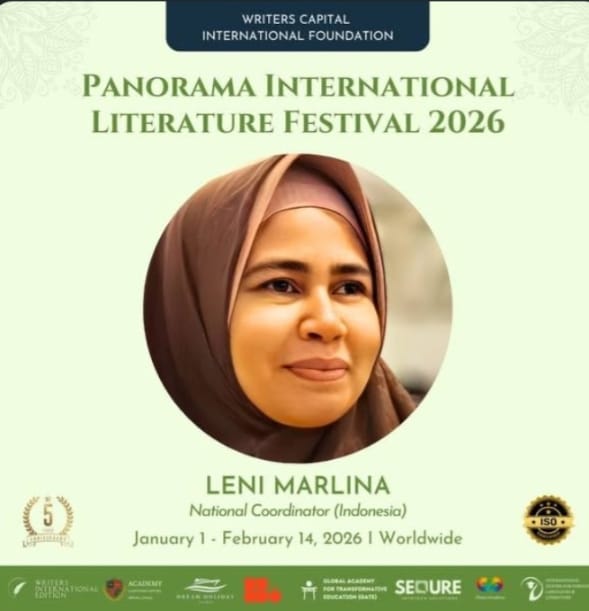
About the Writer — Leni Marlina
Leni Marlina was born in Baso, Agam Regency, West Sumatra, and is currently based in Padang, Indonesia. She is a poet, writer, and lecturer in the English Languange and Literature Department, Faculty of Languages and Arts, Universitas Negeri Padang, where she has served since 2006. Her recent publications include the single-author poetry collections “The Beloved Teachers” (2025) and “L-BEAUMANITY: Love, Beauty, and Humanity” (2025), as well as the trilogy “English Stories for Literacy” (2024–2025). In addition to poetry, she writes short stories, essays, literary criticism, and reviews, and is actively engaged in translating literary and journalistic texts. Across genres, her work consistently positions language as a space for reflection, empathy, and the affirmation of human dignity.
Alongside her academic career, Marlina is deeply involved in literary and cultural journalism. She works as a freelance writer and contributor for various digital platforms and has served as editor and editorial board member for several media outlets, including SuaraAnakNegeri News.com and NegeriNews.com. Her journalistic focus centers on education, literacy, literature, culture, and humanitarian issues, in alignment with a shared commitment to “giving voice to the voiceless.”
Her contributions to literature have received both national and international recognition. She was named Best Writer 2025 by SATU PENA West Sumatra at the 3rd International Minangkabau Literary Festival (IMLF-3), chaired by Sastri Bakry. She is also a recipient of the ACC International Literary Prize 2005, awarded by the ACC Shanghai Huiyu International Literary Creative Media Centre, and has received honors from the international literary community The Rhythm of Vietnam (2025). Since 2025, Marlina has served as Indonesian Poetry Ambassador for the ACC Shanghai Huifeng International Literary Association (ACC SHILA), as well as ASEAN Director for ACC SHILA Poets. In the same year, she was appointed National Director (Indonesia) by the Capital Writers International Foundation for the Panorama International Literary Festival (PILF), held in India in January–February 2026.
—–
The Indonesian version of the essay above is available in the following official link: