SEARCHING FOR WATER IN THE LAND OF TAZIR
A Short Story by
Leni Marlina
(UNP Padang, SatuPena-West Sumatra, KEAI, PLS, ASM, E4LC, Littalk-C)
–
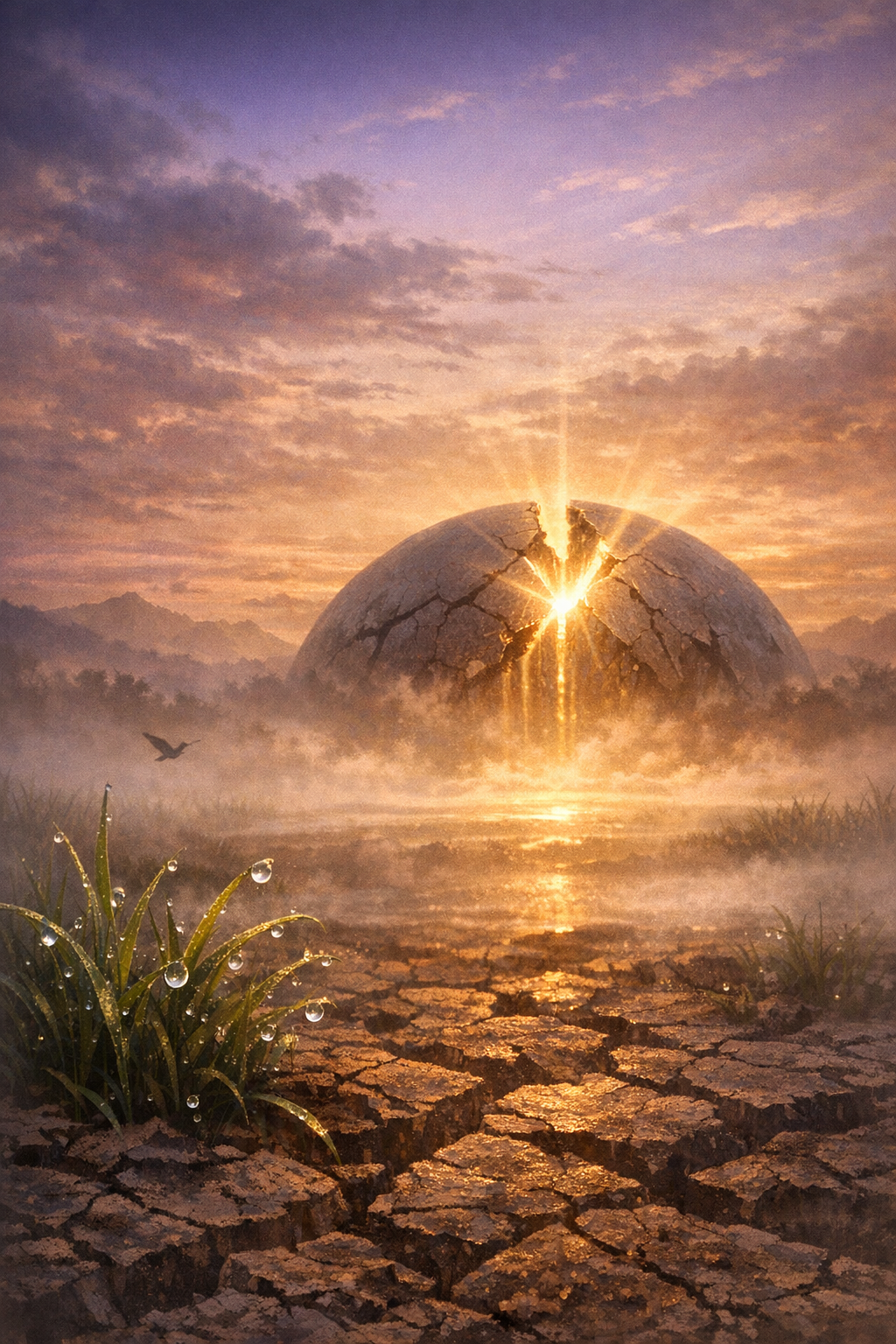
The Land of Tazir split and steamed like ancient skin holding its breath. Its cracks swallowed the secrets of every raindrop that had ever fallen, hoarding the memory of a world on the verge of extinction. Dust danced atop the bones of the earth, tracing shadows of rivers that no longer existed, while the sun—tired of watching—leaned away, ashamed to scorch a surface thirsting for life.
In the village, children learned the word river from stories, not from sight. Water had become myth, a prayer answered only by silence. Sair’s home thrummed at night; its clay walls inhaled with the wind.
Dust clung to his hair, salt to his skin. He had been born after the last flood, when the sky itself seemed to have forgotten how to weep. Gentle and unassuming, Sair carried a quiet light within him—a kindness expressed not in words but in the tender gestures he offered to others, even when he had nothing left to give.
“Water listens, Sair,” his grandfather once said. “It remembers every name whispered to it.”
But his grandfather lay buried beneath a pile of stones, where even the moss refused to endure.
Every morning, Sair climbed the dry well behind the mosque. He lowered a rope into emptiness, touching the air that quivered from heat—a conversation with nothingness. At night, he dreamed of rivers returning to the sky, oceans folding in on themselves, and a whispering voice reminded him:
“When humans forget gratitude, even rivers turn away.”
In Tazir, even silence thirsted. Villagers prayed without ablution, buried their dead in dust, cooked rice with the dampness of their own breath. Yet beneath the gaping skin of the earth, like a cracked heart of the world, something ancient waited—undying, patient.
One morning, the wind shifted. A soft hum rose, as if the very heartbeat of the earth had remembered itself. On a northern hill, Sair’s eyes fell upon a fragment half-buried beneath a flat stone, glowing like a sliver of moonlight imprisoned in glass. The letters throbbed with life, trembling gently in his palms, as though they recognized him.
“You have been found,” a voice whispered inside his chest.
The earth quivered. A fissure opened, releasing a cool breath—damp as a memory long forsaken. Sair knelt, sensing a feeling he thought extinct: the gentle truth of water.
That night, the voice returned, older, intimate:
“Not all thirst comes from the mouth. Not all dryness comes from the soil.”
Sair gazed at the stars, whispering:
“If you remember me, I will remember you.”
Beneath him, the ground throbbed—slow, deep. Something ancient began to stir. A single drop of water hovered, suspended between earth and light, uncertain whether to fall.
Sair left the village before dawn, walking along a path stretched like a pale scar across the valley. Beneath a withered tree, he met a woman with silver threads glinting, surrounded by thousands of jars filled with golden dust.
“Are you seeking water?”
“I seek what water remembers,” Sair replied humbly.
“Then you seek what humanity has forgotten.”
He touched the jars. The scent of greed and sorrow rose.
“Faith cannot melt avarice,” the woman whispered.
“Then you will die of thirst.”
“Perhaps,” said Sair, “but not empty.”
Further on, at the edge of a salt plain, a child hugged a broken bottle containing a single drop of dew.
“Keep it,” Sair said gently. “One day, you will remember that even small things can survive.”
Night cloaked the red horizon. For the first time, Sair spoke aloud:
“If water can remember, what do I remember for it?”
The wind gave no answer. Yet beneath his body, the earth throbbed—a slow pulse awakening an ancient memory.
The Tazir Valley was no longer a valley. It had become a wound, black and silent. Every sound died before it touched the depths. The fragment pulsed, luminous as a falling star. The hum merged with the bones of the earth. Then a voice rose—from soil, from blood, from marrow:
“You carry the final verse.”
“What verse?”
“The one planted within you before birth. This land fell silent because humans stopped listening. They wanted rain without reverence, rivers without reflection.”
Sair pressed the fragment into the soil. The ground trembled; light pierced the crack. From the quivering wound, a spring emerged—clear, cold, alive.
He cupped it in his hands. Forgiveness flowed across his tongue. Clouds gathered. The air felt infinite.
Shadows moved—villagers, soldiers, strangers—their eyes filled with possession.
“Hide if they come in hunger,” Sair whispered. The spring obeyed, sinking into the earth. The valley fell silent again. Thunder rolled for the first time in seven years.
Rain fell—soft, relentless. People cupped their hands, not in gratitude, but in haste. The earth became a mirror: faces reflected thirst, fear, greed, loneliness. Hearts remained deserts.
Sair lay near the spring. Blood mingled with water, forming a small red stream. His eyes half-open, serene—he seemed to have seen beyond human sight.
Water spoke without words:
“I am not for sale. I come to cleanse, not to be owned.”
One by one, humans began to see their own shadows: abandoned children, broken promises, prayers without meaning. Some screamed, some wept, some tried to destroy it—but the water endured.
Soft light radiated from Sair’s chest, spreading through the earth, merging with the water. The first shoots appeared—blue-green leaves, a meeting of sky and sea.
Children stopped crying. Elders bowed, finally understanding: blessings are born not from possession, but from loss accepted with openness.
That morning, Tazir Valley became a garden of water. Rivers flowed, trees grew, air felt renewed—as if the world were reborn from prayer.
Yet Sair vanished. Only a small stone remained at the spring’s edge, faintly inscribed:
“Drought is not in the sky, but in the heart.”
From that day on, the people of Tazir cupped the rain, whispering:
“Wet us—not our bodies, but our barren souls.”
And every rainfall reminded them: this water carries the trace of a single human heart—selfless sacrifice, a reminder that wounds embraced with open hearts can grow hope, compassion, and humanity. Water is not merely to drink, but to cherish, passing from heart to heart—a lesson that humanity is born from the courage to accept pain, and love blooms from awareness of one’s inner drought.
(Victoria – Australia, 2012 & West Sumatra – Indonesia, 2025)
———————————-
About the Author:
Leni Marlina is a writer, poet, and lecturer at Universitas Negeri Padang, West Sumatra, Indonesia, where she has been teaching since 2006. She is the Founder and Head of several digital social communities in the fields of literacy, literature, translation, and creative entrepreneurship, including the Pondok Puisi Inspirasi Pemikiran Masyarakat Indonesia (PPIPM-Indonesia), Poetry-Pen International Community (PPIC), Translation Practice Community (Trans-PC), English Language, Literature and Literacy Community (E4LC), and World Children’s Literature Community (WCLC), among others.
Leni is also an active member of the ACC Shanghai Huifeng International Literary Association (ACC SHILA), the Indonesian Writers Association (SatuPena – West Sumatra), Penyala Literasi Sumbar (PLS), and the World Poetry Movement (WPM) Indonesia.