Traversing the Bridge of Feeling: A Review of Edi S. Febri’s Poem “Sorrow Along the Bridge of Story” (2025)
By Leni Marlina
–

After immersing ourselves in this poem, let us reflect on “Lara Titian Cerita” by Edi S. Febri. Reading it, one feels invited to tread slowly along a fragile bridge—delicate, yet teeming with meaning. This bridge is no ordinary crossing; it is a symbol of life’s journey, a place where hope and reality meet. As Roland Barthes reminds us, “A text is a tissue of quotations drawn from the innumerable centres of culture”—the text is alive, and here, this poem truly breathes amidst the personal and the universal experiences we all share.
Now, observe its short, deliberate lines. They are extraordinary, for each pause makes the reader hold their breath, as if waiting for something uncertain. This evokes Heidegger’s concept of Dasein, wherein we are always being-in-the-world, fully present in lived experience. The poem immerses us in grief, loss, and anticipation. We are truly standing upon that bridge, gazing blankly toward its end, waiting.
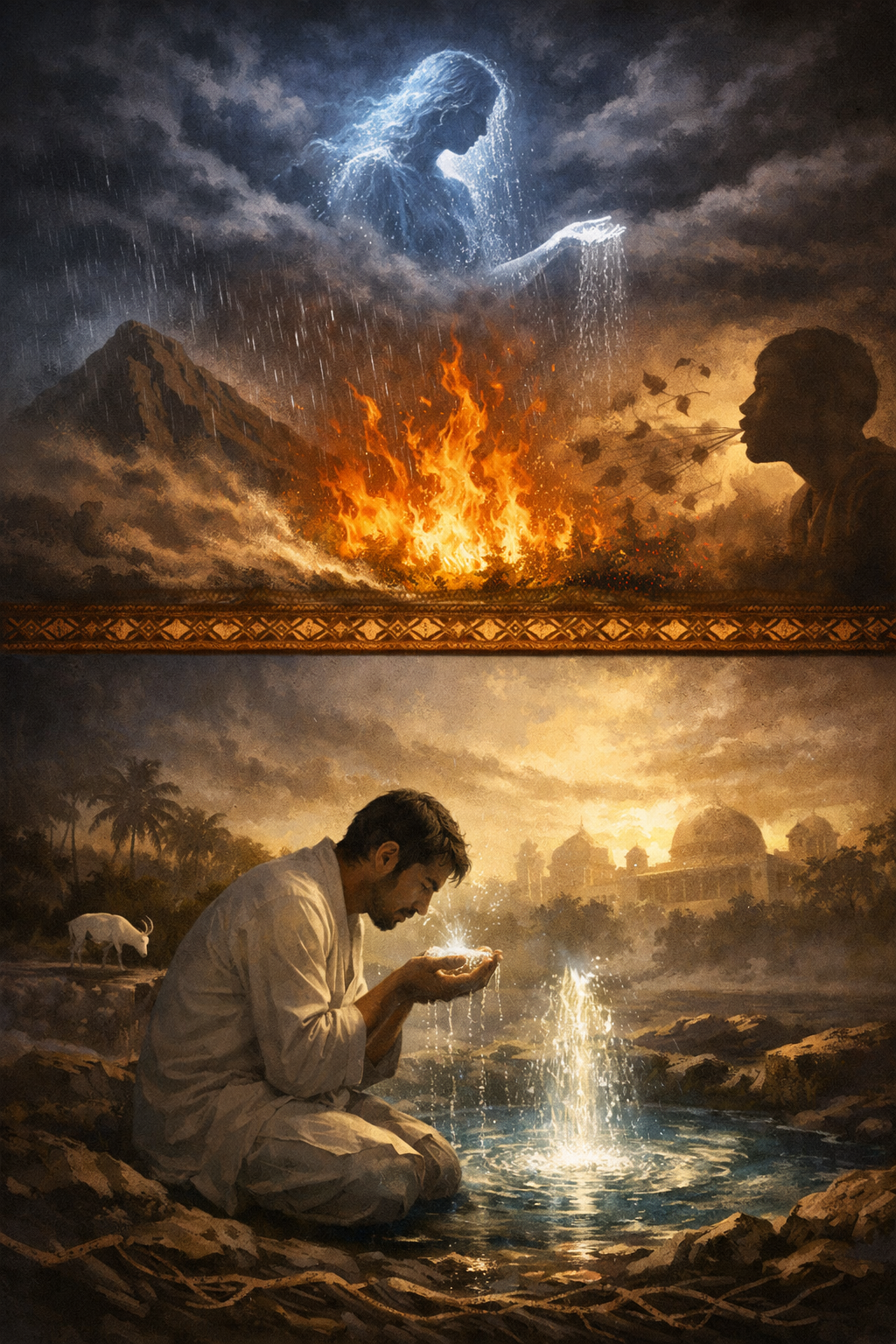
And the symbolism! Night, rain, memory—these are not mere backdrops. Night bears witness, rain cleanses or rends memory, and memory itself… strikes deep into the heart. As Julia Kristeva would frame it, this is the realm of the abject—wounds and sorrow that compel us to confront our fragility. The poem does not conceal its wounds; rather, it allows us to feel them fully.
Notice, too, the vertical alignment of “you” and “I” in the poem. This is ingenious, creating visual space and highlighting emotional distance. The line “I stand at the bridge’s end, awaiting a miracle” is where hope emerges—slender yet tangible. Paul Ricoeur reminds us that narrative helps to give meaning to life’s events. This poem achieves just that: despite our wounds, there is meaning at the journey’s end.
The language itself is simple yet powerful. In Ezra Pound’s terms, it is the “direct treatment of the thing”. No word is superfluous; everything resonates, alive, tangible, piercing. We feel each step along the bridge, standing amidst the rain and the memories that cut sharply.
In conclusion, Lara Titian Cerita is far more than a tale of sorrow. It is an inner journey, prompting reflection, patience, and the nurturing of hope—even if only a fragile glimmer. The poem teaches us that grief is not an end but a space to understand, to contemplate, and to open ourselves to new possibilities.
—
REFERENCES
Barthes, R. (1975). The pleasure of the text (R. Miller, Trans.). Hill and Wang.
https://archive.org/details/pleasureoftext0000bart
Eliot, T. S. (1920). The sacred wood: Essays on poetry and criticism. Methuen.
https://www.gutenberg.org/ebooks/57795
Heidegger, M. (1962). Being and time (J. Macquarrie & E. Robinson, Trans.). Blackwell.
https://archive.org/details/beingtime0000heid
Kristeva, J. (1982). Powers of horror: An essay on abjection (L. S. Roudiez, Trans.). Columbia University Press.
https://archive.org/details/powersofhorrores00kris
Pound, E. (1935). Make it new. Alfred A. Knopf.
https://archive.org/details/in.ernet.dli.2015.185999
Ricoeur, P. (1984). Time and narrative (K. McLaughlin & D. Pellauer, Trans., Vol. 1). University of Chicago Press.
https://archive.org/details/timenarrative0001ricu
———————
SORROW ALONG THE BRIDGE OF STORY
Poem by Edi S. Febri
Translated (Indonesian-English) by Leni Marlina
There is disappointment
Yet it must be accepted
Suppressing desires
Unable to resist
The choice has been made
Embrace a hand whose owner is unknown
Anchoring in the night
The falling of anticipation
A discordant song for a reason
It is more than mere feeling
There is a heart that speaks
A waiting with no path
Whispers once uttered
Silent in the stillness of rain
Cutting through memory
you
are no longer part of it
I
stand at the bridge’s end
awaiting a miracle
There is sorrow
A storm of a story
GRS, 08.10. 2025
—————————————
About the Poet: Edi S. Febri
Born in Batang, Central Java, on February 6, Edi S. Febri began writing in middle school and has since dedicated himself consistently to poetry. To date, thousands of his poems have been written, compiled in hundreds of collective anthologies, and in a single-author poetry collection, “METAMORFOSIS” (Anara, 2021).
In addition to poetry, Edi also writes short stories, though less prolifically. In March 2025, he published a novel, “Nyanyian Pucuk Cemara”, marking an important step in his prose work. Today, he continues to work as a journalist, intertwining his passion for words with his daily profession.
The Indonesian version of the literary review above is available for public by clicking the official link below:
Menyusuri Titian Rasa: Review Puisi “Lara Titian Cerita” Karya Edi S. Febri (2025)