LENI MARLINA’S POEMS COLLECTION: “THE WORLD THAT REMAINS AWAKE”
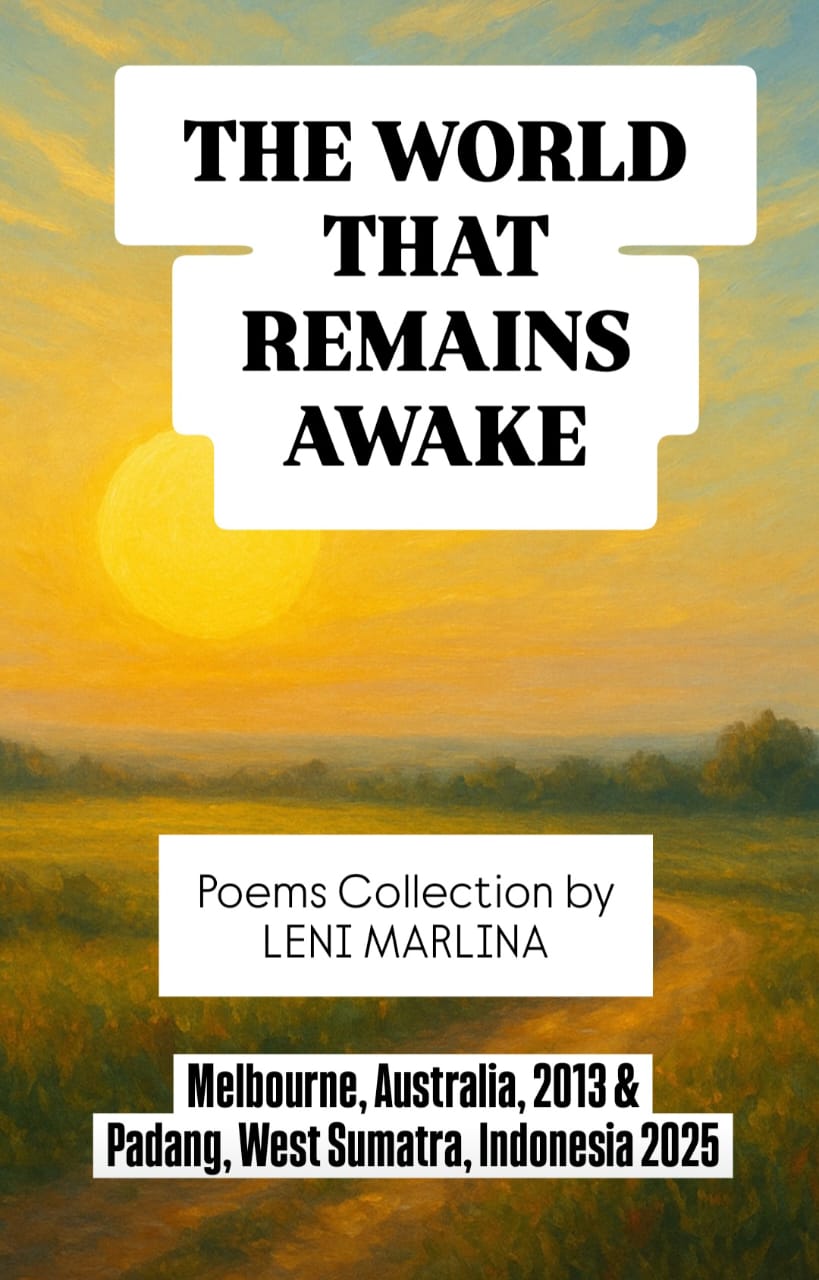
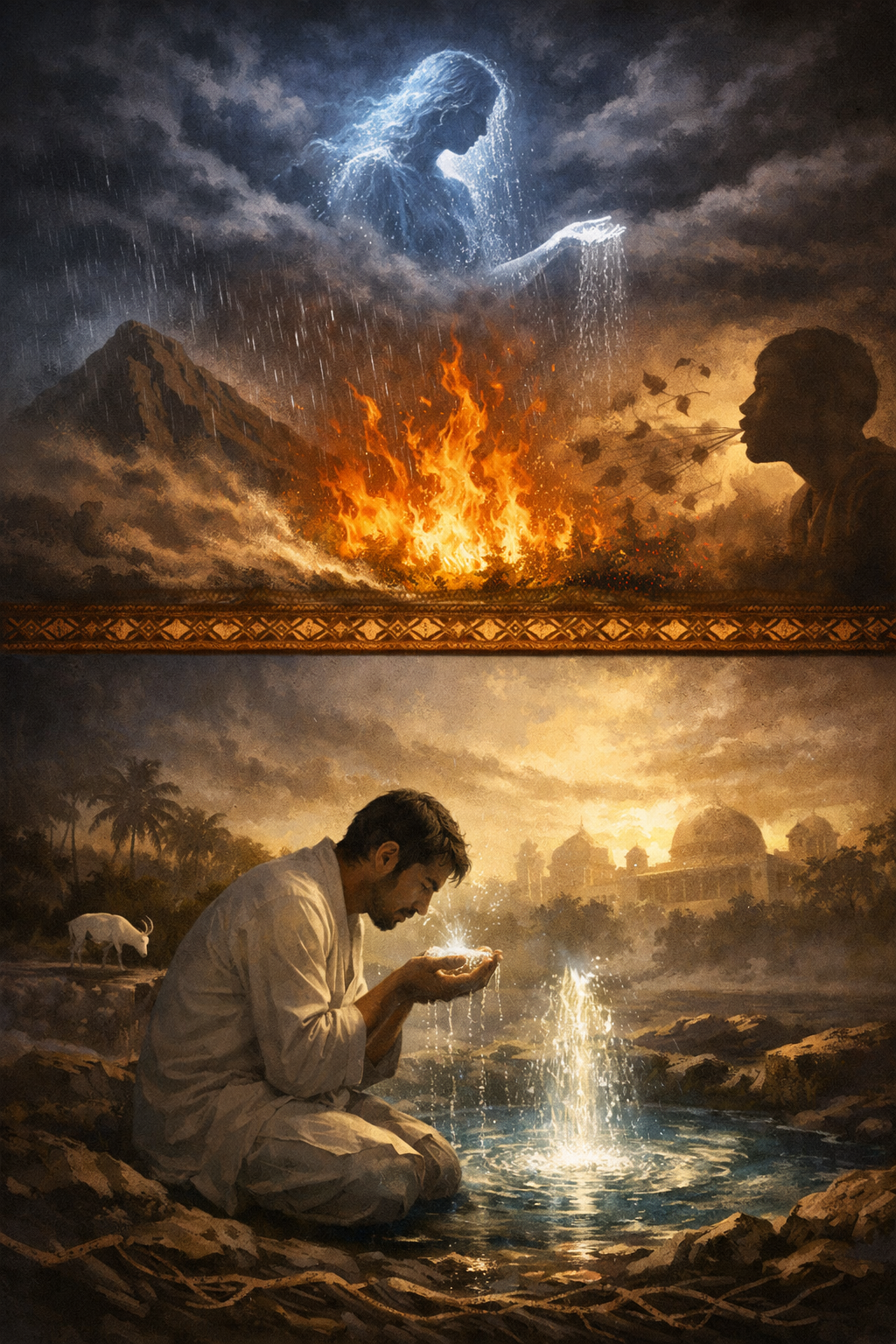
Illustration of Leni Marlina’s poems collection “The World that Remains Awake”. Image Source: © Starcom Indonesia, Book Cover Collection No. 45_15122025 & IG@lenimarlina_starmoonsun.
/1/
The World That Remains Awake
Poem by Leni Marlina
_
Morning is born without turning its head.
Light spills from the sky
like warm milk,
yet the earth’s tongue is bitter—
it grinds rusted iron,
smoke that has forgotten its origin,
and promises that perish
before learning how to leaf.
Hours stand upright inside crystal towers,
moving their hands
like bones trained into obedience.
Time does not move—
it is arranged, commanded,
folded like a map
that no longer remembers the way home.
Beneath hurried footsteps,
the earth breathes with difficulty.
Its scent: damp soil braided with frightened sweat—
an inheritance without ancestry.
Amid the uproar, silence is born—
not as a grave,
but as an infant
laid in the corridor of history,
learning how to cry
without witnesses.
Melbourne, Australia, 2013 &
Padang, West Sumatra, Indonesia 2025
—
/2/
When the World Demands Outcomes
Poem by Leni Marlina
_
Morning does not arrive—
it is hauled from the throat of night,
reeking of wet iron and shattered glass,
like rain that once forgot
how to ask the earth for consent.
Fingers pry open a light
slick and cold,
a light that devours names
and regurgitates them
as numbers.
In this room, sound crowds itself
like dead fish at a river’s mouth—
gleaming, breathless.
Ears are full; meaning starves.
Language stands in haste,
its bones brittle,
its skin patched with icons,
its voice squeezed
until only a mechanical hum survives.
There are high chairs
that have never known dust;
upon them sit the hours,
trained only to count,
to weigh days on sterile scales, to declare wounds “complete”
before they have learned to breathe.
Yet the body keeps an archive
no seal can authorize.
Beneath the skin, memory pulses—
the smell of rivers invading houses,
the taste of soil between teeth,
the cold that swiftly learns
how to reach the bone.
Silence is not empty.
Silence is crowded
with restrained heartbeats,
with tears trained in decorum,
with questions forbidden
to linger.
Poetry arrives not as remedy,
but as a wooden bench
beside a burning road—
a place to sit briefly,
to gather scattered breath.
Listen:
slow words carry gravity.
They bear the scent of ancient rain,
the salt of honest wounds,
a light that does not blind
because it rises from within.
When the world demands outcomes,
poetry offers pause.
When the world commands speed,
poetry holds longer.
When the world names everything,
poetry permits the unnamed to remain alive.
At last, night learns restraint.
Within the folds of darkness,
meaning is not concluded—
it is guarded,
like a small fire
refusing extinction
because something
still needs warmth.
Melbourne, Australia, 2013
Melbourne, Australia, 2013 &
Padang, West Sumatra, Indonesia 2025
/3/
Language Torn from the Body
Poem by Leni Marlina
_
Once, words had skin.
They were warm,
easily bruised,
harboring secret pulses.
Now they are stripped naked
beneath cold lights,
pressed thin
to fit hurried eyes.
Touch a word—
it does not respond.
No warmth.
No tremor.
No admission of pain.
Language drifts
without soles,
like data-dust forgetting
the salt of tears,
like prayers turned bitter
after failing to pierce the night.
What is longed for is not eloquence,
but a single sentence
that bleeds slowly,
one brave enough to dwell
inside the human body
without seeking permission
from metrics and targets.
Melbourne, Australia, 2013 &
Padang, West Sumatra, Indonesia 2025
—
/4/
Chairs That Have Never Known Backs
Poem by Leni Marlina
–
At the summit of time’s architecture,
rows of cold chairs stand—
they have never learned
the shape of a spine.
There, stone hands
redirect rivers
without ever touching water.
Crowns of numbers
are placed upon the wind,
and the wind forgets
how to be gentle.
Below, aging soles
carry maps of the world.
Small bodies
press their mouths to the earth to be certain
it is still real.
Of power, life teaches
through a single grain of rice that falls quietly
yet still longs
to give life.
Melbourne, Australia, 2013 &
Padang, West Sumatra, Indonesia 2025
—
/5/
The Silence You Ask About
Poem by Leni Marlina
_
The silence you ask about is not empty.
It is full of voices too honest
to be announced.
Within it, a mother speaks
to a photograph that will not answer,
a child stores hunger
as a private scripture,
a human being holds themselves together
to avoid coming undone.
Silence sits
like an old guest—
never invited,
always knowing when to arrive.
Poetry does not chase it away.
Poetry pours warm water,
lets the steam rise,
and whispers: sit,
I will not rush you.
Melbourne, Australia, 2013 &
Padang, West Sumatra, Indonesia 2025
—
/6/
Between Noise and Prayer
Poem by Leni Marlina
_
We wake not from sleep,
but from vibration—
air calling our names
without knowing our faces.
The day’s first light
touches our retinas
like a stranger’s fingers:
cold, hurried, never asking
whether the soul is ready.
We inhale morning
and taste metal
from words worn thin by overuse.
Language loses its blood,
becomes fragile bone
moved by command
without dream.
Yet the body remembers.
Skin keeps a calendar of wounds,
the tongue recognizes bitterness
not brewed from coffee,
but from days compressed
into numbers.
Under skies crowded
with signs and arrows,
we walk beside silence—
not empty,
but filled with voices
never offered a seat.
Silence cups our ears,
whispers through pores:
of grief shortened by schedules,
of longing forced into summaries,
of prayers that never became complete sentences.
We see cold towers
rising from the ground
without roots of feeling.
Inside dwell beings
breathing through graphs,
measuring life
with iron rulers.
They are not cruel—
only forgetful
of the earth’s heartbeat
weakening beneath their shoes.
We do not accuse.
We do not curse.
We learn to speak
in metaphor,
so anger does not fossilize.
We call them
winds without seasons—
swift in motion,
barren of growth.
We call them
clocks without night—
turning endlessly,
never knowing return.
Amid it all,
poetry arrives not as banner, but as breath.
It reaches us
through small things:
water murmuring between stones,
the scent of soil after hesitant rain,
the texture of wounds
finally allowed to be felt.
Poetry teaches us how to walk slowly
without becoming weak.
It fractures time into syllables,
so life may enter
without running.
We read poetry
with the body: tired eyes,
backs heavy with stories,
chests still willing to believe humans are larger than branded systems.
In that pause,
we recognize one another
without official names—
only fragile beings who know life is not a project,
but an encounter.
We stand
between noise and prayer,
bearing witness
that not all that matters must be broadcast,
and not all silence
means defeat.
If one day
language grows scarce,
let poetry remain—
an emergency shelter
for wounded humanity
not yet surrendered.
For as long as we can feel,
this life
is still worth defending.
Melbourne, Australia, 2013 &
Padang, West Sumatra, Indonesia 2025
—
/7/
If One Day the World Becomes Too Busy
Poem by Leni Marlina
_
If one day the world grows too busy
counting its own pulse,
let poetry
be the breath that remains.
It asks for no towers,
carves no names in stone,
seeks no chair
in the brightest room.
It wishes only to be water
within a fracture,
warmth in trembling palms,
a whisper reminding us:
humans are not broken machines,
but beings who sometimes forget how to return
to themselves.
And there—
between one inhalation
and one release—
meaning finally dares to live
without announcement,
without defense,
simply breathed
slowly.
Melbourne, Australia, 2013 &
Padang, West Sumatra, Indonesia 2025
—————-
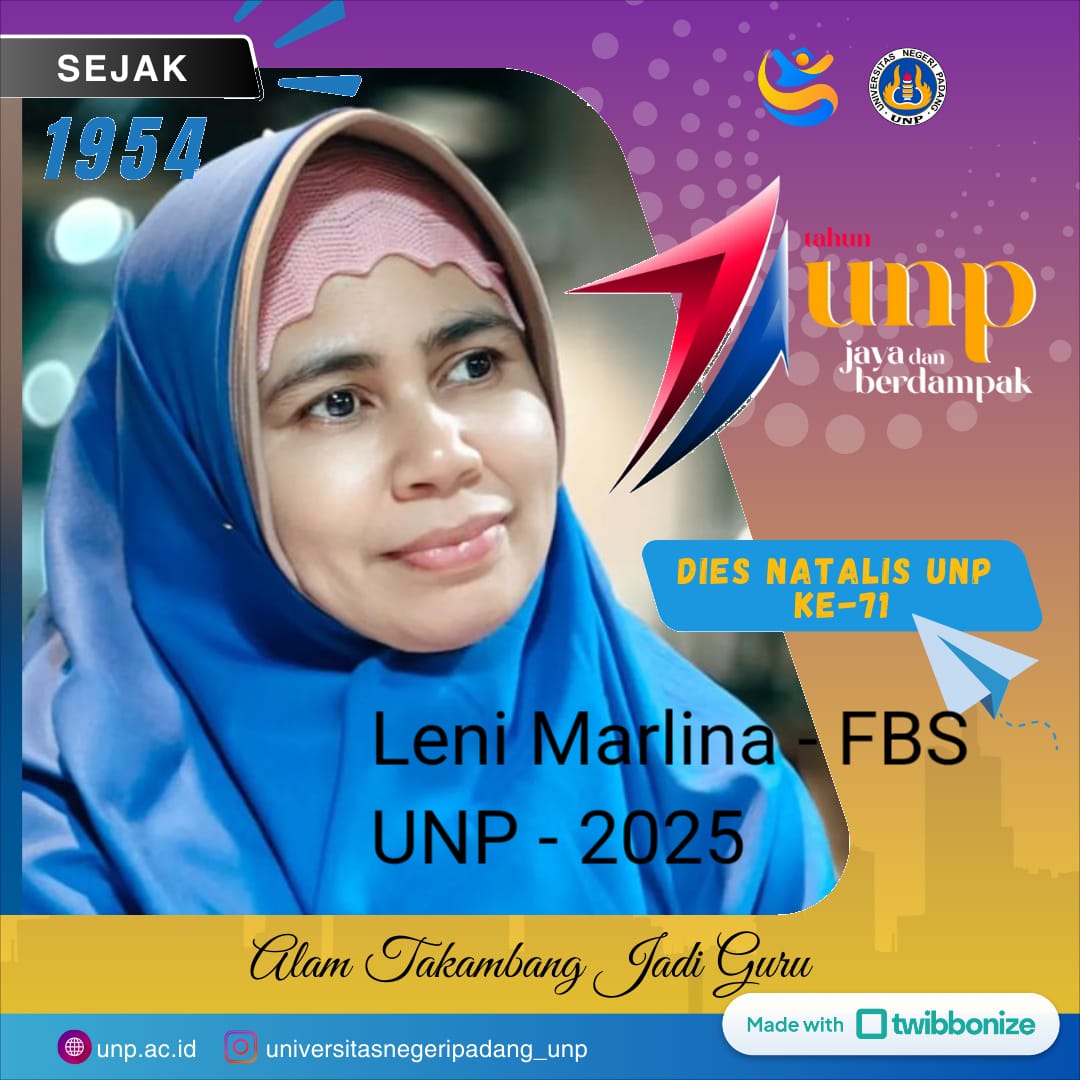
About the Poet: Leni Marlina (Indonesian Poet, Writer, Scholar)
Leni Marlina was born in Baso, Agam, West Sumatra, Indonesia, and now resides in Padang. She is a poet, writer, and lecturer at the English Literature Program, Faculty of Languages and Arts, Universitas Negeri Padang (since 2006).
Since penning her first verses in 2000, Leni Marlina has crafted thousands of poems that trace the inner struggles of the heart, contemplative reflections, urgent environmental and social concerns, enduring humanistic ideas, and a timeless longing for peace. Her words, both delicate and resonant, often bridge the quiet of introspection with the clarity of insight, inviting readers into spaces where thought, emotion, and spirit converge.
During her Master of Writing and Literature studies in Melbourne (2011–2013), she continued to write without pause—using poetry as a sanctuary of awareness, a mirror for the soul, and a compass toward deeper understanding of self and world. Since 2024, she has opened this “ocean of words” to the public through multiple digital platforms, sharing her verse as a living conversation with readers everywhere.
Her recent works include The Beloved Teachers, L-BEAUMANITY (Love, Beauty, and Humanity), and the Trilogy of English Stories for Literacy—a seamless interweaving of devotion, language, and humanistic values. Beyond poetry, she engages in short stories, essays, literary criticism, reviews, and translation of both literary and journalistic texts. Her works appear in various anthologies and digital publications, reflecting a commitment to both craft and outreach.
Outside her academic duties at Universitas Negeri Padang, Leni actively participates in national and international literary communities, founding and leading several literacy initiatives adapted to the dynamics of the digital era. She is the founder and chair of multiple social, literary, and digital movements, including the Pondok Puisi Inspirasi Masyarakat (PPIPM-Indonesia): Indonesian Poetry Readers and Writers Community, Poetry-Pen International Community (PPIC), Literature Talk Community (Littalk-C), and EL4C (English Language Learning, Literature, and Literacy). Through these initiatives, she fosters a culture of reading, writing, dialogue, and reflection across generations.
In recognition of her tireless contributions to literacy and literature, Leni Marlina received the Best Writer 2025 award from SatuPena West Sumatra during the 3rd International Minangkabau Literary Festival (IMLF-3), and the ACC International Literary Prize 2025 from the ACC Shanghai Huiyu International Literary Creative Media Centre.
Through her poetry, scholarship, and community work, Leni Marlina continues to cultivate spaces where words blossom into awareness, empathy, and shared human experience—reminding us that literature is both a mirror and a lamp, reflecting the depths of the self while illuminating the paths that connect us all.
In 2025, she was appointed as Indonesia Poetry Ambassador for the ACC Shanghai Huifeng International Literary Association (ACC SHILA), as well as the ASEAN Director for ACC SHILA Poets. In the same year, she was entrusted by the Capital Writers International Foundation as National Director (Indonesia) for the International Panorama Literary Festival (IPLF 2026, (to join the program, visit www.panoramafestival.org).