Leni Marlina’s Poems Collection: “As Long as Breath May Still Be Borrowed”
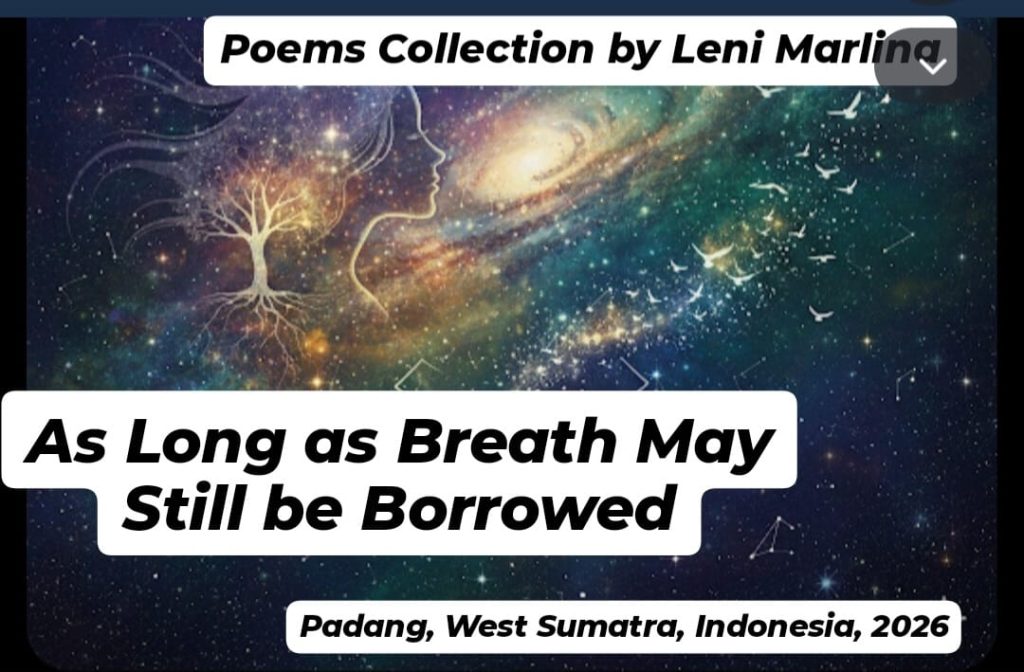
Image: cover of Leni Marlina’s Bilingual Poem: “As Long as Breath May Still be Borrowed”. Image source: Starcom Indonesia’s Poem Cover No. 30. 11012026–LM-NN.
/1/
As Long as Breath May Still Be Borrowed
Poem by Leni Marlina
_
We were not born for haste.
Not shaped for the cruelty of urgency,
not trained to outrun our own shadows.
Time taught us, slowly,
how wounds do not merely pass through the body
but learn its language,
settle into its syntax,
remain not as shame,
not as failure,
but as grammar:
a way the body remembers
it has endured.
We walk slowly,
so the world may pause long enough
to hear itself breathing.
The earth recognizes our soles,
remembers the pressure of our steps.
The air learns us learns the temperature of a fragile chest
that keeps insisting on rhythm
even when it trembles.
So much has been taken
without farewell, without explanation:
voices thinned to echoes,
directions quietly erased,
even the right to hesitate,
even the permission to doubt.
Yet what remains
what stubbornly survives
still demands attention,
still asks us to think,
to think carefully,
to think as an act of courage.
We learned this, over time:
strength rarely announces itself.
It does not always raise its voice.
Often it lives quietly
in the patience to listen longer,
in the restraint of not answering at once,
in the dignity of delay.
Walls rise everywhere,
then forget why they were built.
Meanwhile the body remembers
what it means to lean too long
against something cold,
something unyielding,
something that never intended to hold us.
We plant meaning
where no eye looks,
beyond spectacle, beyond witness.
There, hope grows slowly,
unremarkable, uncelebrated,
rooting itself deep in patience.
And if one day our traces thin, fade,
become unreadable,
let the wind return to them.
The wind knows how to read gently.
It knows how to keep stories
without turning them into stone.
We do not ask the world
to be perfect,
to be endlessly kind.
It is enough
for having space
so humans
do not erase one another.
And as long as humanity breath
may still be borrowed
from one body to another,
from one life to the next,
we will remain
not as noise,
not as spectacle,
but as a presence
that refuses to vanish.
—
Padang, West Sumatra, Indonesia, 2026
—
/3/
Waiting for Words to Arrive on Their Own
Poem by Leni Marlina
_
We learn silence
the way the tongue learns salt
on an unhealed wound
slowly, honestly,
with a sting that teaches restraint.
Stillness settles in the throat,
warm, weighted,
neither empty nor inert,
waiting patiently for words
to descend by themselves.
Morning touches our foreheads
with hesitant hands of light,
uncertain, almost apologetic.
It inhales the scent of night
still lodged
in the folds of breath,
still lingering
where sleep refused to fully release us.
Inside the room,
the clock ticks carefully,
as if afraid to disturb memory.
Time lowers its head,
listens beside us,
offers no commentary,
chooses not to interrupt.
Silence is not vacancy.
It carries a small pulse,
a delicate movement
nudging the chest from within.
There, meaning loosens its skin
without sound, without ceremony like fruit falling
only because it is ready.
—
Padang, West Sumatra, Indonesia, 2026
—
/4/
Where We Set Our Hope
Poem by Leni Marlina
_
We set our hope
into cold ground,
where warmth is never guaranteed.
The soil smells of iron and rain,
of labor and erosion,
yet it receives what we place there
without question,
without judgment.
Our hope does not glow,
does not perform brightness.
It is pale, tentative—
like a leaf uncertain
whether green is still possible.
Still, its roots search for water faithfully,
trusting the dark.
Each morning, the sun arrives like a modest guest
never extravagant,
never demanding attention.
It touches our shoulders lightly,
makes no promises,
offers only enough warmth
for the skin to believe again.
And if one day this hope fractures,
let it crack softly in the chest,
not as collapse,
but as proof a small sound whispering that life,
at least once tried.
—
Padang, West Sumatra, Indonesia, 2026
—
/5/
We and Time
Poem by Leni Marlina
_
Time walks without feet,
yet the floor knows its weight.
It presses itself into surfaces,
into chairs and tired backs,
into aches
that refuse names.
We hear time
in the transformation of voices:
words once sharp now softened,
edges worn down
like old wood
left too long in rain.
Time kisses without permission.
It knows the scent of age
the smell of patience
learned reluctantly,
not chosen.
In the mirror, it smiles faintly,
then leaves without goodbye.
We do not pursue it.
We let time work on us,
erode us gently,
until another shape appears slower, quieter,
more honest with limits.
—
Padang, West Sumatra, Indonesia, 2026
—
/6/
On Being Human
Leni Marlina
–
Being human sounds quiet.
Like wet cloth wrung by hand fatigue audible,
water reluctant
to surrender.
Our skin memorizes touch:
sometimes warmth,
sometimes harm.
Yet the body keeps opening,
because closing hurts longer.
We taste life with a hesitant tongue:
sweet is not always true,
bitter not always wrong.
Flavor teaches patience,
teaches us to delay judgment.
Inside the chest,
the heart does not shout.
It beats like a small lamp
in a long corridor
not bright,
not commanding,
just enough light
to keep us from losing the way.
To be human
is not to arrive quickly,
not to conquer distance,
but to remain
to stay with one another,
even when the world
is never entirely kind.
—
Padang, West Sumatra, Indonesia, 2026
——
About the Poet — Leni Marlina
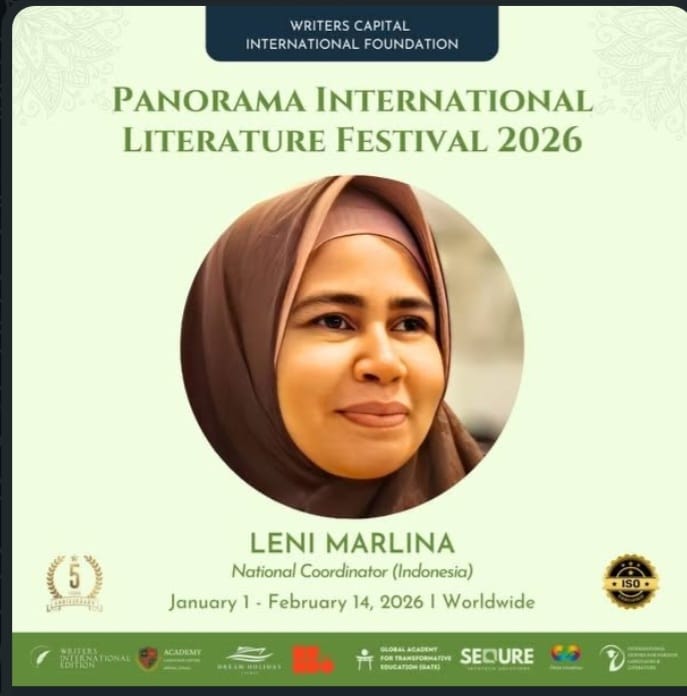
Leni Marlina was born in Baso, Agam, West Sumatra, and currently resides in Padang. She is a poet, writer, and lecturer in the English Literature Program, Faculty of Languages and Arts, Universitas Negeri Padang, where she has taught since 2006. Her recent works include the single-author poetry collections The Beloved Teachers (2025) and L-BEAUMANITY: Love, Beauty, and Humanity (2025), as well as the trilogy English Stories for Literacy (2024–2025). In addition to poetry, she writes short stories, essays, literary criticism, and reviews, and translates a wide range of literary and journalistic texts. Her work consistently positions language as a space for reflection, empathy, and the affirmation of human dignity.
Alongside her academic career, Leni is actively engaged in literary and cultural journalism. She works as a freelance writer and contributor across various digital platforms and serves as editor and redactor for several media outlets, including Suara Anak Negeri News (https://suaraanaknegerinews.com/) and Negeri News (https://negerinews.com), focusing on education, literacy, literature, culture, and humanity. Both platforms are driven by a shared commitment to “giving voice to the voiceless.”
Her contributions to literature have received national and international recognition. She was awarded Best Writer 2025 by SATU PENA West Sumatra at the 3rd International Minangkabau Literary Festival (IMLF-3); received the ACC International Literary Prize (2005) from the ACC Shanghai Huiyu International Literary Creative Media Centre; and was honored by the international literary community The Rhythm of Vietnam (2025). Since 2025, she has served as Indonesian Poetry Ambassador for the ACC Shanghai Huifeng International Literary Association (ACC SHILA), as well as ASEAN Director for ACC SHILA Poets. In the same year, she was appointed National Director (Indonesia) by the Capital Writers International Foundation for the Panorama International Literary Festival (PILF), held in India in January–February 2026.