Leni Marlina’s Short Story: Ms. Puti Ambun and the Space of Thinking
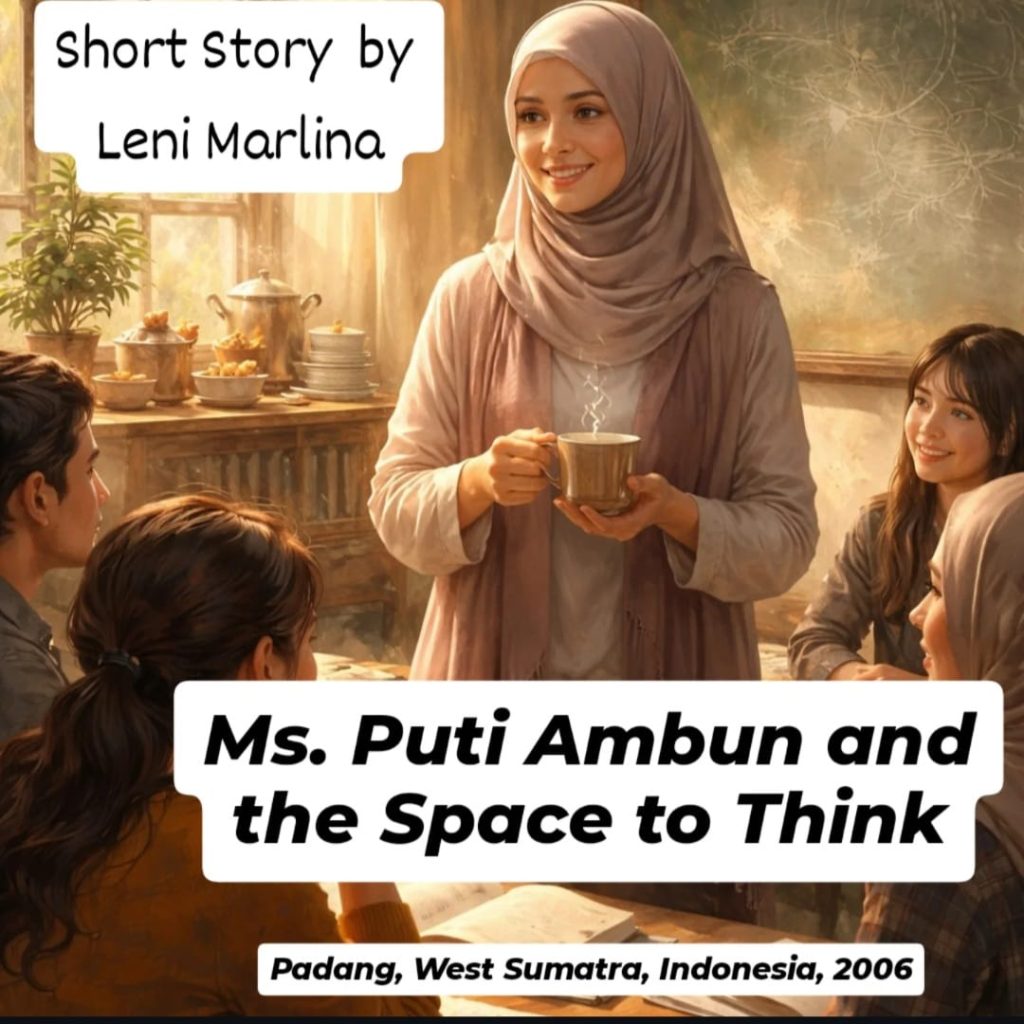
A Short Story by
Leni Marlina
–
Ms. Puti Ambun was a familiar name among the academic community of the campus. Her hair, once silver-threaded black, framed a face marked by calm eyes and a smile that carried quiet reassurance. Over the years, she began wearing a hijab when she went to teach, yet that gentle smile never changed. What truly distinguished her, however, was not her appearance, but the way she created space: space for thinking.
In the Faculty of Humanities, Ms. Puti’s classroom was always different. There were no fixed answers written boldly on the board. Instead, there were questions, conversations, fragments of theory, long discussions, and… cups of ginger tea.
That morning, sunlight poured through the tall windows. Students shuffled through books and notes some hesitant, some curious.
“Does anyone have a question today?” Ms. Puti’s voice cut gently through the room.
Rani, one of the students, stood up.
“Ma’am… will all these theories truly make us honest human beings? Or will they only turn us into people who know how to please numbers?”
Silence settled. Heads lowered. Breath was held.
Ms. Puti looked at Rani, then slowly at the entire class.
“Honesty,” she said, “is courage. The courage to ask, to doubt, to remain human. That matters more than numbers though the world often chooses to judge numbers first.”
She poured warm ginger tea into a white enamel cup. Its sharp aroma spread quietly through the room.
“Ginger tea cannot be rushed,” she continued. “Neither can thinking. Warmth comes only after the sharpness.”
Arga, another student, rose hesitantly.
“Ma’am… what if that courage leads us in the wrong direction? What if the system punishes us for asking too many questions?”
Ms. Puti smiled softly.
“If courage leads us astray, we correct it together. But if fear keeps us from asking, you lose yourselves. Systems may judge, but conscience cannot be deceived.”
Rani turned to Arga.
“You hear that? Asking isn’t wrong even when we’re afraid.”
“Yes,” Arga replied quietly, “but the fear remains.”
Ms. Puti met their gaze.
“Fear is always there. Courage is not the absence of fear, but the willingness to ask despite it.”
Weeks later, news reached the lecturers’ office. The dean summoned Ms. Puti to a meeting. The room felt tense, fluorescent lights reflecting sharply off the long table.
“Your reflective classroom has drawn attention,” the dean said.
A senior colleague added, “It could disrupt accreditation and faculty standards.”
Ms. Puti raised her hand calmly.
“What is happening is not a threat. It is an experiment in preserving space for thought not to oppose the system, but to keep humanity alive in the classroom.”
A younger colleague spoke, uneasy.
“But the students ask too many questions, Ma’am. They challenge authority.”
Ms. Puti smiled faintly.
“Their questions are not a threat. They are signs that education is alive. When questions disappear, education dies.”
After the meeting, Ms. Puti sat in the campus canteen. Rani approached her, anxious.
“Ma’am… are they angry?”
Ms. Puti poured ginger tea.
“Perhaps. But they listened. That matters more than anger.”
Rani lowered her eyes.
“I’m afraid of being wrong.”
Ms. Puti smiled gently.
“Fear is human. But the courage to keep asking even while afraid that is real learning.”
A senior lecturer stopped Ms. Puti in the hallway.
“Ms. Puti… this is dangerous. Students are becoming too vocal. Performance evaluations could suffer.”
Ms. Puti met his eyes steadily.
“It is more dangerous to silence them. Their fear will turn into a long muteness that erodes intellectual integrity.”
He fell silent.
“Courage,” he murmured, “is costly.”
Ms. Puti smiled quietly.
“Then let me pay that price. But the price of silencing students? That, I refuse.”
Weeks later, another faculty meeting was held. The pressure intensified.
Several lecturers urged Ms. Puti to follow the curriculum rigidly.
Ms. Puti stood, her voice firm.
“I respect the curriculum. But the curriculum exists for humans not humans for the curriculum. When we erase the space to ask, we erase their humanity.”
A young lecturer whispered,
“But accreditation, publications what about those?”
Ms. Puti lowered her gaze, then looked up.
“What is accreditation without integrity? What is publication without courage? We may win on paper, but students lose themselves and that loss cannot be repaired.”
The dean took a sip of water. Silence filled the room. Even those who opposed her said nothing, subdued by her calm resolve.
Back in class, Rani spoke softly.
“Ma’am… I used to be afraid of being wrong. Now I know asking matters, even when answers are uncertain.”
Arga smiled.
“And I’ve learned that grades don’t define courage. Courage defines our worth as humans.”
Ms. Puti looked at them, smiling.
“And that is my purpose not to change the system overnight, but to light a fire that does not easily die.”
At Pak Rahman’s small stall, the scent of ginger tea lingered in the air. Ms. Puti sipped slowly.
“Ms. Puti,” Pak Rahman said, “they’re beginning to understand. But this is only the beginning.”
Ms. Puti nodded.
“Yes. They are beginning to listen to themselves. And that is far more important than listening to instructions.”
Pak Rahman smiled.
“Like ginger, Ms. Puti. Sharp first, warmth later. Never instant, but always lasting.”
The faculty issued a special evaluation note for Ms. Puti. They acknowledged that her reflective method yielded tangible results, though it differed from conventional standards.
Ms. Puti accepted it calmly, knowing that true victory lay not in official recognition, but in having safeguarded a space where thinking and humanity could breathe.
In the final class of the semester, she looked at her students.
“Your grades may be recorded. Your courage will not appear in documents. But it will live on always.”
Rani wiped away tears.
“Thank you, Ma’am. I learned how to be human.”
Arga smiled.
“And I am ready to ask even when afraid.”
Years later, Pak Rahman’s stall no longer stood. Yet every student who once sat in Ms. Puti’s class carried that stall within their hearts. Whenever they faced pressure or moral dilemmas, they paused, imagined a sip of ginger tea, and whispered:
Ask bravely. Remain human. Trust the process. Warmth follows sharpness.
Ms. Puti Ambun retired quietly, without ceremony. But in every rain-soaked afternoon, in the scent of ginger, and in honest conversations, her legacy endured.
Education is not merely about numbers, publications, or formal standards.
Education is the space where humans are allowed to remain human.
—
(Padang, West Sumatra, Indonesia, 2006)
——–
The Indonesian version of the short story is available in the official link below: