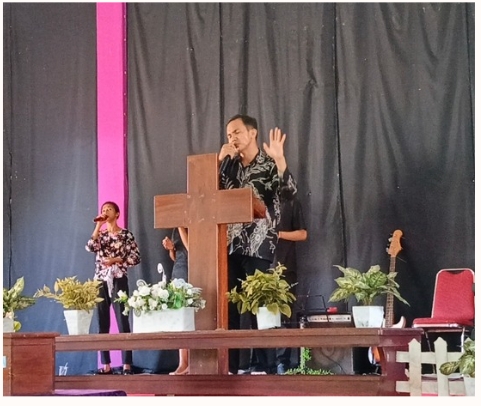
THE SIXTH ANNIVERSARY OF IKDKI (Indonesian Catholic Lecturers Association) on Saturday, November 22nd, 2025 — UNTAR Hall, Jakarta
Report by Paulus Laratmase
Translated (Indonesian-English)
By Leni Marlina, Editor of Suaraanaknegerinews.com
–
The sixth anniversary of the Indonesian Catholic Lecturers Association (IKDKI) was marked by a keynote address of uncommon depth from Prof. Dr. Roberth Kurniawan Ruslak Hammar, S.H., M.Hum., M.M., CL, the recently appointed Rector of Universitas Caritas Indonesia (UNCRI). Prof. Hammar, who also chairs IKDKI for West Papua and Southwest Papua, delivered a lecture entitled “At the Eastern Edge of Knowledge: Reflections on Silence, Hope, and the Future of Higher Education in Papua.”

He opened with an observation that immediately quieted the auditorium: in West Papua alone, fifteen higher-education institutions stretch from Manokwari to Teluk Bintuni lands resting upon forests, seas, oil fields, and gas reserves. Yet within this vast academic landscape, only forty Catholic lecturers serve. When Southwest Papua is added home to thirty-five universities and colleges the number barely shifts. Small, understated, but defiantly luminous.
Across Papua, 127 higher-education institutions operate. Under LLDIKTI Region XIV, seventy-four are private institutions and within these, only two individuals have attained the rank of full professor. Prof. Hammar is one of them, the first full professor ever to emerge from a private university in Papua—a milestone that is as historic as it is scholarly.

Carrying numerous leadership roles—including Chair of IKDKI West and Southwest Papua, Secretary of APTISI West Papua, Chair of LP3KD, BPSMI, PAPPRI, BP PTSI West Papua, Head of Eastern Indonesia Empowerment at DPP APTISI, Deputy Chair of APHA, Deputy Chair of AMUSTRA, and Rector of UNCRI (established in 2024 through the merger of two colleges) Prof. Hammar spoke with the clarity of someone whose insights are shaped by lived realities.
His foremost concern was urgent: the critical shortage of Catholic lecturers in a region so expansive and complex. He expressed hope that IKDKI would accelerate academic advancement. Fifteen lecturers have now reached the rank of Associate Professor (Lektor Kepala), positioning them on the cusp of becoming full professors. This, he underscored, is not merely aspiration—but a mandate for the future of Papua.
Yet the challenges, he admitted, are formidable. The academic readiness of prospective students is deeply uneven. The strongest graduates are recruited into elite universities outside Papua such as UI, UGM, and Unhas, or into leading public institutions within Papua including Uncen, UNIPA, and Musamus. The next tier of students enter major private universities outside the region. Meanwhile, the third to fifth tiers populate private universities within Papua, institutions that continue to battle resource deficits and quality constraints.

With disarming theological humor, he remarked:
“If God were to ask who should enter heaven first, I believe the lecturers of Papua would be ahead of the rest.”
A line greeted with laughter—yet steeped in respect for those who teach amid adversity.
He emphasized that research laboratories are an urgent necessity. Without them, Papua’s universities remain observers rather than contributors within the global knowledge economy. Equally pressing is the need for government-appointed lecturers (DPK) at private institutions. Although regulations are restrictive, Prof. Hammar is pressing for continued dialogue with MENPAN and BAKN, insisting that education must not be constrained by rigid bureaucracy.
A sobering moment emerged when he disclosed that 35 percent of university students in Papua drop out due to financial hardship. “These are not statistics,” he emphasized. “They are young lives cut short—not by lack of intellect, but by lack of means.”
He urged for improved access to the KIP Tuition Program, recommending direct ministry disbursement to avoid political interference.

Concluding his address, Prof. Hammar invited the audience to envision a future both distant and attainable.
“Building Papua,” he said, “is not merely erecting university buildings. It is nurturing people who believe they are worthy of competing.”
From his podium in bustling Jakarta, his words carried the quiet resolve of the East: that the struggle to elevate education in Papua is not solely a policy matter, but a moral responsibility. That the lecturers laboring in silence are, in truth, guardians of a fragile lantern of civilization.
And though small, that lantern continues to burn. Through the collective strength of IKDKI and steadfast commitment, it will shine ever brighter—lighting the path toward a Papua that is just, enlightened, and profoundly humane.
The Indonesian version of the news article above is available in the following official link: