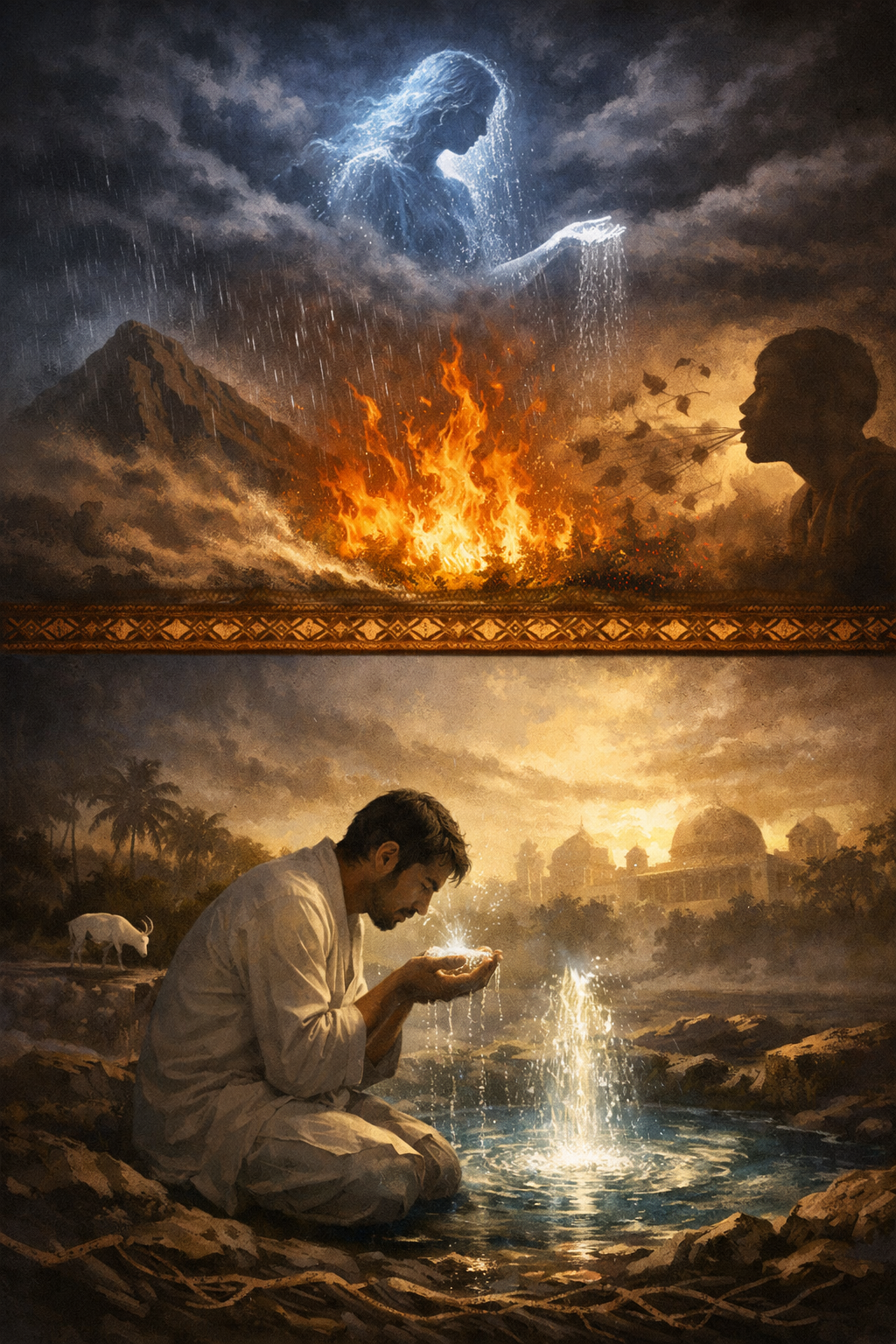
LENI MARLINA’S POEMS COLLECTION: TORRENTING RAIN AND THE FOREST THAT REVEALS ITS SECRETS AND WOUNDS
/1/
TORRENTING RAIN AND THE FOREST THAT REVEALS ITS SECRETS AND WOUNDS
Poem: Leni Marlina
Rain descends—
shivering the earth’s thin skin,
a knuckle tapping on a buried door,
announcing a presence
that refuses to name itself.
Every drop strikes the ground
in a syntax no scholar has mapped,
a language that predates speech,
that outlives comprehension.
From forests gasping for breath,
from slopes that have forgotten
the will to stand,
long trunks plunge downward—
incising the night with their falling.
They do not collapse;
they are compelled—
dragged by a gravity thick with tidings
of a loneliness
abandoned by its sentinels.
Mud coils into pigments
no human archive has ever catalogued.
It gathers shards that once stood upright,
fragrances that once had gardens,
and wounds that choose
their own inheritors.
Houses tilt—
consonants stripped of their vowels—
their pillars inscribing the catastrophe
without daring to speak it aloud.
In currents that swallow the yard,
roofs drift off,
bearing footprints
that no longer recall the feet
which made them.
The flash flood lifts
what was never meant to travel:
a window yawning open to nowhere,
a chair pirouetting in search of its floor,
a wall clutching the memory of voices
though its room has disappeared.
In the uproar without sound,
the sky gathers itself—
not to menace,
but to reveal.
It offers a bitter ledger:
rifts, ruptures, erasures—
laid bare without ceremony.
The earth, breathing in fragments,
attempts to reassemble its shape,
like a body tracing the fracture
of its own bone
without granting itself a scream.
Yet among the splinters,
a small insistence stirs:
a hand lifting a fallen beam,
a silhouette bracing another
through brown, trembling water,
eyes meeting the mud
with the stubbornness of staying.
Such gestures
neither bargain nor implore.
They simply exist—
like roots refusing surrender
in soil undone.
And when at last
the torrent loosens its grip,
when the wood ceases its wandering,
when the soil remembers its weight,
an archive remains:
the earth inscribing,
the water recalling,
the sky admonishing—
and the human, belated
yet not broken,
beginning to read
what was once refused.
Flash Flood, Sumatra Island, Indonesia, 2015 & 2025
/2/
THE EARTH SPEAKING THROUGH A DARKENED CURRENT
Poem: Leni Marlina
No one is ever truly prepared
when the underground voice
suddenly rises
to the surface.
It does not shout—
it merely hisses,
like something held too long
under the tyranny
of silence.
The rain that fell that night
summoned neither wind
nor lightning.
It summoned shadows—
shadows that clung
to the seams of roots,
waiting for the moment
the body of the earth
grew weak.
In the valley once green and full,
the water arrived without a face.
It bore no grudge—
yet it remembered
all that had been forgotten.
It traced the narrow path
once trodden by deer,
followed the fractures
left behind by years
of thinning seasons.
Buildings that once stood firm
surrendered themselves
to that unfamiliar voice.
They did not collapse—
they bowed,
like someone who suddenly realizes
another body
has long been sharing
his burden.
Amid the thickening current
were objects that first seemed trivial:
a cloth still holding
the faint perfume of soap;
a spoon
that had not finished cleansing the morning;
a piece of wood
that once held a tired back.
All of it whirled
like letters
seeking a new sentence
to decipher their loss.
The sky closed its distance;
its gray pigment
blurred the boundary
between near and far.
Behind that heavy curtain
lay a murmur—
of hundreds of footsteps
losing direction,
of small voices
refusing to vanish
within a chaos
that chooses nothing.
Yet in the dark of the water
something else appeared:
a resolve
harder than the stone
dragged by the flood.
Someone shut a door
to keep the wind out.
Someone lit a lamp
so the night would not thicken.
Someone lifted another body
on the verge of surrender.
These gestures
were not defiance—
they were recognition
that humanity
was never meant
to walk alone.
And when at last
the water allowed itself
to recede,
the exposed earth
released a tender sound,
like a whisper
suddenly audible:
that every vanished trace
has its successor,
that every wound laid open
forms a new map,
that each disaster
teaches humanity
to see itself
with a truth
the bright days
never demand.
Flash Flood, Sumatra Island, Indonesia, 2015 & 2025
/3/
THE VOICE LEFT BEHIND THE CURRENT
Poem: Leni Marlina
There are moments
when the passing water
carries not only objects
but also a voice
never meant
to escape the mouth
of the earth.
That voice arrived
as a thin vibration—
touching stone,
leaf,
even the fragile air
hanging between wet trunks.
No one heard it whole;
only fragments
fell upon the ear
like messages
written half-conscious.
In a dusky hamlet
embraced by the blur of evening,
people stepped outside
for reasons they could not name.
They stood at the edge
of a road
no longer holding its shape,
as if searching for something
older
than their fear.
The water that passed
was not high,
yet it carried a pulse
that stilled them.
The river—
long called by sweet names—
introduced itself
by another name,
a name not gentle
but true.
Among the current
floated a photograph
spinning with the waves,
its smiling lips
untroubled by the shifting world.
There was a scarf
looped around a thin branch,
like a hand
unwilling to release
its final hope.
A flat stone
slid slowly away—
and with it
the stories
once seated upon it.
The sky thickened
not with clouds,
but with the realization
that something
had moved too far.
Its color descended,
settling upon the water,
forming a sheen
that made the current
appear like a magnified vein.
Yet humans
have their own way
of returning.
Someone walked
along a crumbling edge—
reading the incomplete tracks
and following them anyway.
Someone lit a small voice
within himself,
a voice that whispered
the names of home,
of love,
of loss,
and persisted
though no echo responded.
When night settled
and the water began to ease,
the scattered voice
found its body again.
It did not revert to words—
it became a decision:
that humans
will keep standing
even when their ground trembles;
will keep walking
even when their path dissolves;
will keep searching
even when what they seek
has drifted far beyond reach.
Flash Flood, Sumatra Island, Indonesia, 2015 & 2025
/4/
THE SKY THAT KEEPS THE WATER’S FACE
Poem: Leni Marlina
There are days
when the sky is not merely overcast—
it becomes a second surface
reflecting the face of water
with an accuracy
almost frightening.
Beneath it,
the earth closes its eyes,
as if hiding
from something only it knows:
a subtle stirring from within,
a cold insistence
creeping like a bad memory
waking from long sleep.
The rain descends
without uproar,
without rage.
Its silence
shakes the frail bodies indoors,
as though some distant note
had called their names
without permission.
In that density
the water gathered itself—
not as flood,
not as stream,
but as intention:
a liquid decision
made long ago
behind root, stone, and stillness.
Trees abandoned by their companions
on the hillside
bowed momentarily,
releasing a faint sound
understood only by the wind.
Not lament—
but confession:
they too
have known fear.
The roof
quivered briefly
before accepting its new weight.
Walls held themselves steady,
trying to remember
what it meant
to shelter
without resisting.
In the yard
almost stripped of form,
a lone lantern glowed—
the only light
that asked for nothing.
It flickered,
as if trying to harmonize
with the shifting water
that redrew every inch
of the night.
And at the center of it,
humans stood.
Not to resist—
but to understand.
One touched the surface
seeking something
that had yet to be named.
Another closed their eyes
and listened to the old world
splitting softly
into two.
When dawn finally arrived
with heavy steps,
the sky handed back
the water’s face.
It withdrew
without trace,
keeping a silence
readable only
by those who witnessed
the night to its end.
And the earth,
though torn and soaked,
retained a single truth:
that humans
are never truly strong,
yet always—
always capable
of rekindling light
even when yesterday’s flame
has been carried away.
Flash Flood, Sumatra Island, Indonesia, 2015 & 2025
/5/
AFTER THE FLASH FLOOD
Poem: Leni Marlina
After the flash flood, something fell out of language:
morning appeared like a light that had forgotten itself,
touching the shore with a trembling hand,
as if afraid to touch what the night had dragged away.
Sand—usually soft, obedient—
became a page crushed by a merciless fist.
Upon it, long trunks emerged
as phrases uprooted from a vast manuscript
the mountain had hidden
through seasons of withholding.
Those timbers were not merely wood.
They might be the bones
of a displaced landscape,
or dark documents torn
from the library of the forest
and flung to the sea
before fearful hands could erase them.
Some still bore the stain of rain
like blind graffiti carved by a storm;
while those brooding giants
stretched like a chronicle gone weary—
one that had resolved
to write itself
without an editor.
The sea observed them
without eyes, without intent—only with movement:
approach, retreat, consider, return—
a rhythm closer to interrogation
than tide.
No sawdust.
No tree-cry.
No addresses left behind.
Yet irony thickened
within the grain—
like something once red
now choosing another color
to continue its story.
At the edge of the heap
a curved branch rested
with an odd, almost shameful grace—
resembling a crescent fossil
or the final letter of an alphabet
being rolled back
by a hand too clean
to be remembered.
Its arc pointed upstream—
toward the place where roots once negotiated
with stone, time, and weather;
toward the place where light arrived
without fear of itself.
Now that upstream exists
only as a faint seeped shadow
on the backs of discarded driftwood.
The beach became an archive machine
that switched itself on—
its pages opening
like a chest ready
yet startled
by what lay inside.
Finally the sea whispered,
in a voice like metal cracking against wind:
Who peeled the slopes,
then hid their fingers
behind the terms “project” and “progress”?
Who traded the pulse of earth
for numbers that are always hungry
and never say thank you?
Who shifted the borders of life
into the deepest pocket
until the river lost
its dictionary?
The questions walked
along the shoreline
bare, unadorned.
No one answered.
Perhaps the answer is this:
The air turned fragile,
the coast shivered,
and the wood lay stranded—
wild metaphors refusing
to bow to the hands
that once commanded them.
The shore—
which only wished to be an edge—
became a new language for grief:
an echoing chamber
recording names
too frightened to be spoken.
For nothing torn from the slopes
ever truly disappears;
it merely chooses another place
to reveal
its origin.
And upstream and downstream—
they are one creature:
when one wound opens,
the whole body
turns red.
Flash Flood, Sumatra Island, Indonesia, 2015 & 2025
—-

About the Poet: Leni Marlina (UNP Padang, PPIPM-Indonesia, PPIC, SatuPena West Sumatra, KEAI, ACC SHILA, PLS, PILF)
Leni Marlina was born in Baso, Agam, West Sumatra, and currently resides in Padang. She is a poet, writer, and lecturer in the English Literature Study Program at the Faculty of Languages and Arts, Universitas Negeri Padang, where she has been teaching since 2006. Her life and work merge education, the arts, and the pursuit of meaning through words, silence, and imagination.
Writing poetry since 2000, Leni Marlina has produced thousands of works reflecting contemplative thought, environmental and social issues, humanity, and the pursuit of peace. During her Master’s studies in Writing and Literature at the University of Melbourne (2011–2013), she continued to write, using poetry as a quiet space that awakens awareness. Since 2024, she has opened her “ocean of words” to the public through various digital platforms.
Her recent works include the single poetry collections The Beloved Teachers (2025) and L-BEAUMANITY: Love, Beauty, and Humanity (2025), as well as the trilogy English Stories for Literacy (2024–2025). Beyond teaching, she is actively involved in national and international literary communities and has founded several literacy and digital literature initiatives.
As the founder and chair of multiple social, literary, and digital literature movements—such as PPIPM-Indonesia (Indonesian Poetry Readers and Writers Community), Poetry-Pen International Community (PPIC), Literature Talk Community (Littalk-C), and EL4C (English Language Learning, Literature, and Literacy)—she continues to bridge generations through literature, fostering cultures of reading, writing, and reflection.
Leni is also an active member of SatuPena Sumbar, the Komunitas Penyala Literasi Sumbar (PLS), and numerous other communities dedicated to language, literacy, literature, and culture.
In recognition of her dedication, she received the Best Writer Award 2025 from SatuPena West Sumatera at the 3rd International Minangkabau Literacy Festival (IMLF-3), and the ACC International Literary Prize 2005 from the ACC Shanghai Huiyu International Literary Creative Media Centre.
In 2025, Leni was appointed Indonesian Poetry Ambassador to the ACC Shanghai Huifeng International Literary Association (ACC SHILA) and further entrusted with the role of *ASEAN Director for ACC SHILA Poets. In that same year, the Capital Writers International Foundation named her National Director (Indonesia) for the International Panorama Literary Festival (IPLF) 2026, scheduled for January–February 2026 (www.panoramafestival.org).
——
The Indonesian version of the poems collection above is available in the following official below:
KUMPULAN PUISI LENI MARLINA: HUJAN DERAS DAN HUTAN YANG MEMBUKA RAHASIA DAN LUKA