Festival of Nusantara Ethnic Poetry 2025: A Living Memory
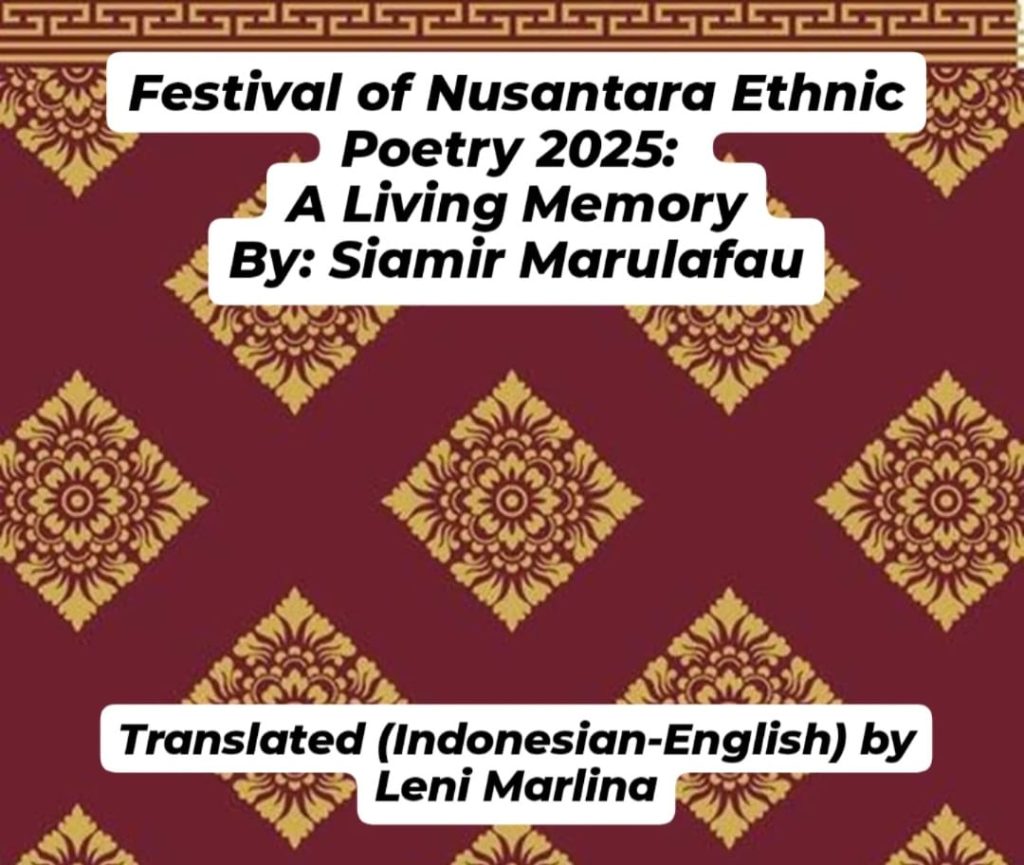
Image: Cover of Siamir Marulafau's work: "Festival of Nusantara Ethnic Poetry 2025: A Living Memory". Image Source: Starcom Indonesia's Cover No. 11.04012026 - LM-SAN.
By: Siamir Marulafau
Translated (Indonesian-English) by Leni Marlina
—
December has its own quiet way of staying with me. Each year, it returns not only as a month on the calendar, but as a space where memories linger. It was in December that I found myself recalling a journey—one that did not merely move my body from one city to another, but gently stirred my feelings, my hopes, and my belief in the deeper meaning of literature.
Almost a year earlier, the initiator of PERUAS had shared some news with me: I was invited to take part in the writing of Nusantara ethnic poetry. I did not tell many people. I kept it to myself, the way one keeps a prayer—silently, carefully. There was a calm happiness in my heart, along with a hope that slowly began to grow. To me, this opportunity was not only about writing poetry; it was also about the possibility of setting foot in a neighboring land I had known only through stories—Johor Bahru, Malaysia.
In time, the poem was written. It spoke of history, and when I learned that it had passed the mentor’s curation, my hope felt more real, more grounded. Yet life, much like poetry, often takes unexpected turns. The Festival of Nusantara Ethnic Poetry, originally planned for Johor Bahru, was moved to Jambi. The committee conveyed the news simply, but for me it awakened curiosity rather than disappointment. Jambi was still a distant name in my life—a place I had never visited before.
A friend once asked me, “Why isn’t it being held in Johor Bahru, Sir?”
I smiled. I did not have an answer. Perhaps Jambi itself was calling us.
Toward the end of November 2025, the country faced another trial. Flash floods struck several provinces. Roads were damaged, and news of loss arrived one after another. I began to worry: would the land route from Medan to Jambi still be passable? Unable to quiet my thoughts, I went the next day to the Rafi Bus counter and asked directly, “Is the Medan–Jambi route still open?”
The answer was simple—and comforting. The eastern Sumatra route was still safe. The buses were still running.
In that moment, I felt certain: this December was truly a blessing.
On December 18, 2025, I set out for Jambi. The festival was scheduled for December 20–21, with its opening night held at the Official Residence of the Governor of Jambi. A land journey of nearly twenty-seven hours was not easy, but I chose to leave early, giving both body and spirit the time they needed to arrive fully.
The opening night felt alive and sincere. Members of PERUAS came from many regions, and poets from Malaysia were also present. I felt deeply honored to be asked to lead the opening prayer. Afterward, I found myself seated beside a representative of the Governor of Jambi. Without formality, he spoke of his appreciation for the festival. Events like this, he said, mattered—not only as celebrations of literature, but as invitations to literacy and as efforts to nurture the quality of younger generations, especially junior and senior high school students.
“What an extraordinary literary evening,” he said.
I nodded, wholeheartedly.
I also shared my admiration for Mr. Asrizal Nur. To me, he is not only an accomplished literary figure, but a guide and a protector. While many write in pursuit of recognition and stages, he chooses instead to open doors for others—to encourage them to write, to read, and to love literature. Even those who had never written a pantun, a gurindam, or a poem before are now given space to learn and to grow.
The festival unfolded smoothly until its closing at the Official Residence of the Mayor of Jambi. One moment, in particular, stayed with me: when the City Secretary read a poem in the style of Sitor Situmorang—brief, unadorned, yet deeply resonant. It reminded me of Rembulan di Atas Kuburan. In that moment, I realized once more that literature never chooses its audience—it simply reaches whoever is open to it.
In the end, the Festival of Nusantara Ethnic Poetry 2025 in Jambi became more than an event. It became a meeting point—between poets and poems, between culture and memory, between people and the land beneath their feet. The poets read their works from the Anthology of Nusantara Ethnic Poetry at the opening, the closing, and during poetry readings at the temple site. Each voice carried its own rhythm; each poem left its own quiet trace.
And I know this journey will remain with me for a long time—as memory, as lesson, and as a quiet conviction that literature still has a home in this country.
(SM – Ed. by LM-SAN)
—
About the Writer
Siamir Marulafau is an Indonesian academic, poet, short story writer, and essayist from Medan, North Sumatra. He holds a Ph.D. in Language, Arts, Culture, and Literature and currently serves as a lecturer at the Vocational University of North Sumatra. His literary work is grounded in reflective humanism, where language becomes a space for moral reflection, existential awareness, and an intimate dialogue between nature and the human soul.
As an educator, writer, and poet, he views literature as a space of responsibility—one that safeguards memory, sharpens empathy, and gently resists excess through contemplation. His works have appeared on various literary platforms and continue to contribute to the evolving discourse of Indonesian poetry and literary criticism.